| Diese Seite auf Deutsch! |
|
Cephalopods (Cephalopoda) - Part 2Behaviour, Ecology and Reproduction |
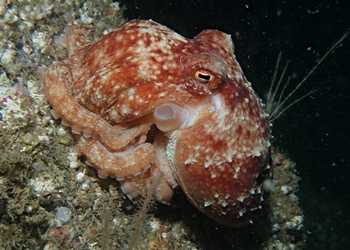 Lesser Octopus (Eledone cirrhosa): Pembrokeshire, Wales, UK. Note the funnel (siphon). Photo: Phil Newman (iNaturalist)  Enlarge Image!
 |
| Part 1 |
Part 2

|
Part 3 | Part 4 |
|---|---|---|---|
Despite their relatively low number of species compared to other molluscan classes, cephalopods have successfully adapted to a remarkable variety of marine habitats and lifestyles throughout their evolutionary history. As a consequence, their methods of feeding, locomotion and defence differ considerably. The swift, arrow-like squids racing through the open ocean are greatly different from the leisurely drifting nautiluses and cuttlefish, as well as from the octopuses that "walk" across the sea floor. Particularly remarkable are the abilities of many cephalopods to change both colour and body shape and to camouflage themselves in a variety of ways. In some languages, many cephalopod species are referred to as "inkfish", since they live in the sea and they use ink for protection or defence.
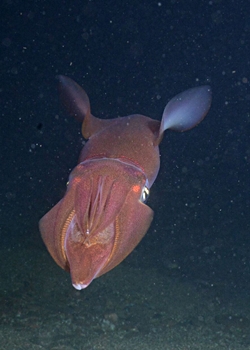
All living cephalopods are carnivorous, with the exception of the rather primitive deep-sea Vampire Squid (Vampyroteuthis infernalis), which feeds on detritus, i.e. decaying organic matter, sometime also referred to as "ocean snow". Like other molluscs, cephalopods as well are equipped with a radula, or rasping tongue, which they use to process the soft tissues of their prey. In addition, they have evolved the upper jaw into a hard, chitinous beak resembling that of a parrot, which they use to crack open shells and exoskeletons of their prey. In most cephalopods, this beak is also used to cut food into smaller pieces, since the brain, arranged in a ring around the oesophagus, allows only food particles below a certain size to pass and be swallowed.
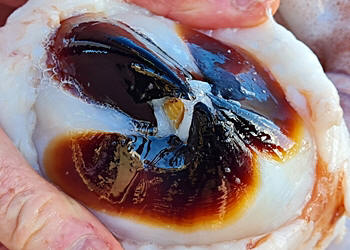 Beak of a Giant Squid. Photo: Marian Oliver (iNaturalist). |
|
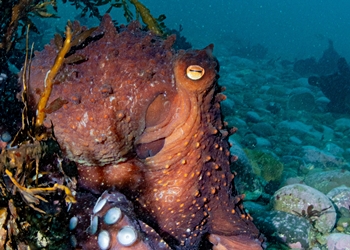
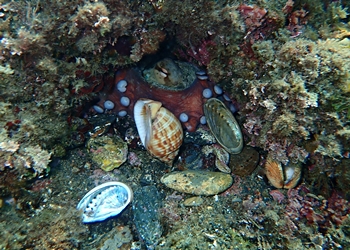 Common Octopus (Octopus vulgaris) in its lair with remains of its prey: Girona, Catalonia, Spain. Photo: Manelor (iNaturalist).
Enlarge Image! |
Secondly, most coleoid species - that is nearly all "modern" living cephalopods - possess little or no shell. Palaeontologists are therefore faced with the problem that shell-less cephalopods rarely leave fossils, except their beaks, making it all the more remarkable when a fossil octopus-like cephalopod, or in this case more likely a member of the Vampire Squids (Vampyromorpha; see Cephalopod Systematics), can be identified solely from its fossilised beak. Based upon the excavation of such a beak, it has been proposed that Nanaimoteuthis haggarti, which presumably lived during the Late Cretaceous, approximately 100–72 million years ago (see Geological Time Periods), may have reached a mantle length of up to 19 metres and thus potentially exceeded the size of a modern Giant Squid (Architeuthis dux). However, such estimates are by no means universally accepted.
 |
| Ikegami, S. et al. (2026): "Earliest octopuses were giant top predators in Cretaceous oceans". Science 392 (6796), S. 406 - 410. (Abstract). |
| |
|
Dr.
Polaris: "Cretaceous
Kraken? Nanaimoteuthis, The Largest Octopus To Ever Live".
( YouTube Video).
 |
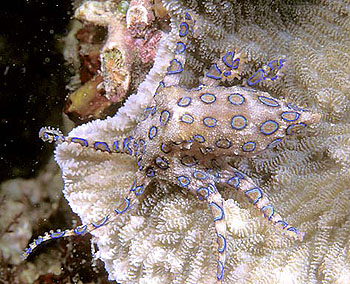 Greater Bluering Octopus (Hapalochlaena lunulata), Philippines. Photo: Jeffrey Rosenfeld. Source: The Vibrant Sea. |
The prey of cephalopods is as different as is their lifestyle. Squids primarily hunt fish and shrimps, but also other cephalopods, including smaller squids and octopuses. Their elongated feeding tentacles provide a decisive advantage, since they can seize their prey before it is even aware of their presence. The predominantly benthic octopuses, on the other hand, are usually rather highly specialised predators of hard-shelled prey such as snails, bivalves and crustaceans.
To overcome such prey, octopuses use their powerful beak to break open shells and exoskeletons and then consume the soft tissues using the radula. In many species, a paralysing neurotoxin in the saliva assists in subduing the prey. Apart from that, octopus saliva also contains a variety of digestive enzymes, including chitinases that weaken the exoskeletons of crustaceans and proteases that liquefy the soft tissues of the prey.
Since in octopuses the radula is often considerably reduced, they instead use a specialised salivary papilla located beneath the radula to drill holes into the shells or exoskeletons of their prey. To do so through the shell of a cockle, for example, an octopus needs approximately three hours. It then injects its enzyme-rich saliva through the opening and subsequently sucks out the nutritious juices.
Nixon,
M. (1980): "The salivary papilla of Octopus as an accessory radula for drilling
shells". Journal of Zoology, 190: 53-57. (Abstract).
Some octopus species are even capable of using venom for defence. The usually inconspicuous Blue-ringed Octopuses (for example Hapalochlaena lunulata) display their characteristic bright blue ring patterns only when threatened or aggressive. They have the potent neurotoxin tetrodotoxin at their disposal, which is also present in pufferfish and in side-gilled sea slugs (Notaspidea). Thus, misjudging a small, inconspicuously brown Australian octopus can also become quite dangerous and in some cases even fatal, to humans.
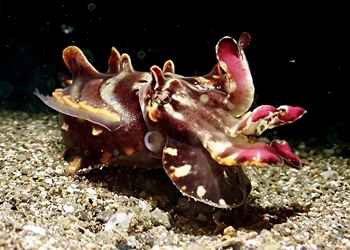 Flamboyant Cuttlefish (Ascarosepion pfefferi): Calabarzon, Philippines, South China Sea. Photo: Mikejdo (iNaturalist)
Enlarge Image! |
|
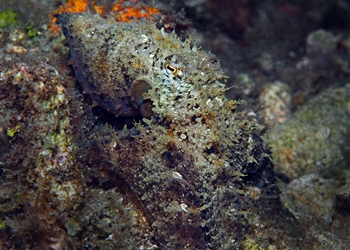 The Algae Octopus (Abdopus aculeatus) preferably camouflages as a sea snail overgrown with algae. Bitung, Sulawesi, Indonesia. Photo: Pauline Walsh Jacobson (iNaturalist)
Enlarge Image! |
|
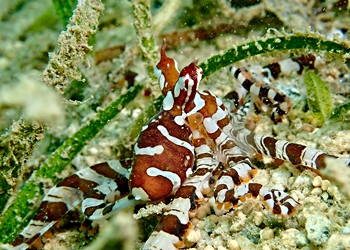 Wunderpus photogenicus is a species of octopus specialised in mimicry: Lombok, Bali Sea, Indonesia. Photo: Alexandra Rawden (iNaturalist).
Enlarge Image! |
|
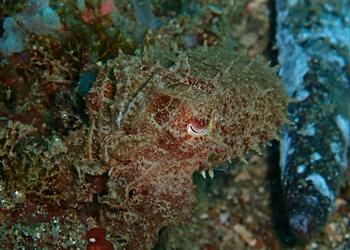
Cuttlefish - The Stealthy Ambush Hunters
Photo: Eva Paulus (iNaturalist): Lembeh Island, Indonesia. |
Beneath the chromatophore layer, a second layer contains so-called iridophores. These cells consist of thin chitinous plates that function as interference reflectors, reflecting specific wavelengths of light and producing shimmering blue, green and silvery colours. Beneath those, there is a third layer composed of so-called leucophores. Unlike iridophores, leucophores act as broadband reflectors, scattering ambient light whose wavelength progressively shifts towards the blue end of the spectrum with increasing water depth.
Cephalopods utilise the combined action of these three cell types for camouflage, among other purposes, by matching their colouration to the surrounding substrate. Cuttlefish and octopuses are even capable of reproducing complex patterns such as checkerboard designs.
| |
| Innovationsreport (2006) (German): Oktopus-Haut als Superreflektoren. |
| |
| Max Planck Institut für Hirnforschung (2023) (German): Tarnung bei Kopffüßern: Die Suche nach guten Übereinstimmungen. (Link). |
| |
|
Science Friday:
Where's The Octopus? (
YouTube Video). |
| |
| Woo, T.; Liang, X.; Evans, D.A. et al. (2023): The dynamics of pattern matching in camouflaging cuttlefish. Nature 619, 122–128. (Link). |
Many cephalopods also can communicate their emotional state through colour displays. For example, they may send waves of contrasting colour bands across their bodies when stressed, such as during encounters with rival conspecifics. On the other hand, the Flamboyant Cuttlefish (Ascarosepion pfefferi; image upper left) lives up to its name by displaying striking colouration even when at rest.
Jeffrey Rosenfeld:
Flamboyant Cuttlefish on
The Vibrant Sea.
Some cephalopods, such as the Broadclub Cuttlefish (Ascarosepion latimanus; image right), also use colour change during hunting. Then the colour patterns are not only used for camouflage but also to distract and possibly even hypnotise prey, usually crabs and other crustaceans. When Ascarosepion latimanus encounters a potential prey, it approaches slowly while rhythmically flashing changing colour patterns. The distracted prey fails to react in time and, once the cuttlefish is sufficiently close, the two long grappling tentacles are deployed suddenly, seizing the prey and passing it to the eight shorter arms. Those take it to the mouth, where it meets its end at the beak. Squids like the Humboldt squid use flashing colour displays in a similar manner to confuse schools of fish and thereby improve their hunting success.
BBC Earth:
Cuttlefish Hypnotises Prey. (
YouTube Video).
BBC Earth:
Colour
Changing Squid Mating Ritual. (
YouTube Video).
Deep Look:
You're Not
Hallucinating. That's Just Squid Skin. (
YouTube Video).
Discovery News:
Cuttlefish
- Chameleons of the Sea. (
YouTube Video).
Octopuses on the other hand, display different colour patterns too, depending on whether they are relaxed or aggressive. Venomous species such as the aforementioned Blue-ringed Octopuses (for example Hapalochlaena lunulata) also use their colouration as a warning signal for potential predators.
Many cephalopods, particularly cuttlefish and octopuses, can change not only their colouration but also their body shape. By contracting specialised muscles beneath the skin, they can raise or flatten structures known as papillae, thereby modifying the texture of their skin. This ability helps them avoid detection by both predators and prey. Combined with colour change, and occasionally supported by the use of ink (see below), this makes for the extraordinary camouflage abilities cephalopods are deservedly famous for.
One particularly remarkable example is the octopus with the memorable name Wunderpus photogenicus (image left), which occurs in the Bali Sea of Indonesia and was not formally described until in 2006. It is capable of assuming the appearance of other animals as a form of protective mimicry, including venomous lionfish (for example Pterois antennata), sea snakes and various other fish. It differs from the very similar Mimic Octopus (Thaumoctopus mimicus) in the patterning of its suckers and its predominantly nocturnal lifestyle.
The Algae Octopus (Abdopus aculeatus) on the other hand, found in northern Australia, Indonesia and the Philippines, derives its name from its preferred disguise as an algae-covered snail shell. It is also among those octopus species known to leave the water temporarily while foraging, moving between neighbouring tidal pools.
MolluscaBase eds. (2021):
Wunderpus photogenicus Hochberg, Norman
& Finn, 2006.
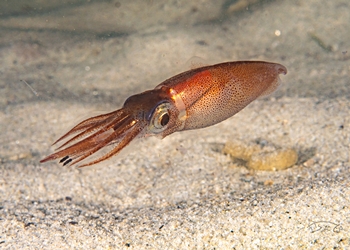 Firefly Squid (Watasenia scintillans): Toyama, Honshu, Japan. Photo: Kisaland (iNaturalist)
Enlarge Image! |
In addition to their affinity to alter colour and shape, many cephalopods are also capable of bioluminescence. More than seventy squid species are known to produce biological light. This bioluminescence may be generated either by symbiotic bacteria or by specialised cells known as photophores, in which the enzyme luciferase catalyses a light-producing reaction involving luciferin and oxygen. Bioluminescence can serve various purposes, including courtship and camouflage.
For the iconic Giant Squids and Colossal Squids inhabiting the lightless depths of the aphotic deep sea, bioluminescence also assists in orientation and defence. Combined with their enormous and highly developed eyes, which in the Colossal Squid might even be enhanced by bioluminescent structures, these adaptations provide a crucial advantage against sperm whales hunting them with sonar. Unlike the whale, the squid can usually see its predator at distances of around 100 metres and might therefore have a chance to retreat in time, even though the whale's sonar has a slightly greater range.
Among the few bioluminescent cephalopods regularly encountered near the surface are the Firefly Squids (for example Watasenia scintillans; image right). These are found from the East China Sea as far as Japan, where they are also fished commercially.
In some languages, such as German and Dutch, many cephalopods are also referred to as "inkfish". Although they are certainly not fish, the ink that gave rise to this name is indeed characteristic of many species. These cephalopods possess a specialised ink sac located behind the anus, where the ink is produced from pigments and various other chemical substances before being expelled through the funnel.
The functions of ink are diverse. Most obviously, it serves as a defensive mechanism, allowing the cephalopod to deploy a cloud of ink much like a smoke screen and retreat under its cover. Chemical compounds within the ink may additionally interfere with the predator's sense of smell. Some cephalopods can even mix mucus with the ink to create a more coherent structure resembling the shape of the animal itself, thereby confusing potential attackers even further. In certain species, bioluminescent particles may also be incorporated into the ink cloud, providing an additional visual distraction. Ink may furthermore play a role in hunting and courtship behaviour. Some species, such as the Common Cuttlefish (Sepia officinalis), even use ink to colour the egg capsules, helping to camouflage the developing embryos. Many deep-sea cephalopods, on the other hand, lack an ink sac altogether, since in the absence of light there is no need for visual camouflage.
Squids: Jet Swimmers in the Ocean!
Especially when in flight, squids can reach astounding speeds: Japanese scientists have measured a maximum velocity of 11.2 m/s (over 40 km/h or 20 knots), which is more than the fastest known human athlete, Usain Bolt. Source: Spiegel Wissenschaft (2013, Accessed: 02.05.2026). |
|
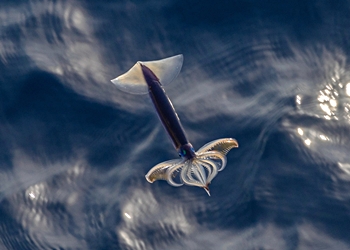 Flying Squid (Ommastrephes bartramii): Southeast of Kyushu, Japan. Photo: Maksim Stefanovich (iNaturalist))
Enlarge Image! |
|
 A school of Flying Squids (Ommastrephes bartramii). Photo: Maksim Stefanovich (iNaturalist)
Enlarge Image! |
Various mantle appendages can also be used for locomotion. Squids, for example, usually have two fins either side of the mantle's posterior end, assisting them in manoeuvring and steering. Cuttlefish, on the other hand, have modified their mantle seam to a broad fin or fringe running along both sides of the body. Undulating movements of this fringe assist locomotion, producing a style of swimming that is considerably more leisurely than that of most squids.
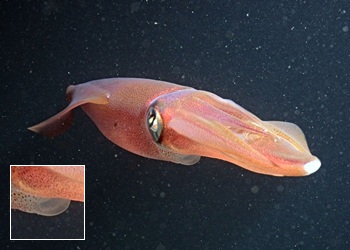
However, unlike its swift relatives, the Caribbean Reef Squid (Sepioteuthis sepioidea) is a relatively slow-moving animal. As a consequence, its terminal fins are greatly extended that they almost resemble the continuous mantle fringe of a cuttlefish. Its scientific name, Sepioteuthis ("Cuttlefish Squid"), points to this superficial similarity to the cuttlefish.
For energy efficiency reasons, swimming cephalopods generally rely upon their fins or mantle fringe at low speeds, reserving jet propulsion primarily for rapid and sudden movement.
Some squids have refined jet propulsion to such an extent, that some members of the Ommastrephidae family (Order Oegopsida, see Cephalopod Systematics) can occasionally leap from the water in large schools. This behaviour has earned them the common name "flying squids". Around Madeira, for example, entire schools of flying squids can sometimes be observed launching themselves from the water, possibly as a means of escaping predators.
Flying behaviour has also been documented in waters around Japan, where species such as Ommastrephes bartramii and Sthenoteuthis oualaniensis have been observed gliding through the air in swarms. Studies have shown that those squids not only propel themselves out of the water using jet propulsion and continue doing so while airborne, but also spread their large fins and broadened arms to increase lift and extend their trajectory. In this manner, they are capable of remaining airborne for up to three seconds and covering distances of approximately 30 metres. Recorded velocities reached 11.2 m/s, equivalent to more than 40 km/h or about 20 knots.
Wikipedia:
Ommastrephidae.
Muramatsu,
K. et al. (2013): "Oceanic squid do fly". Marine Biology, 160. (PDF).
In contrast to the predominantly free-swimming cuttlefish and squids, although cuttlefish generally rather remain close to the sea floor, octopuses are primarily adapted to a benthic lifestyle. They feed mainly upon crustaceans and molluscs, including snails, and many species also employ venom during hunting (see Nutrition in Cephalopods). Unlike their free-swimming relatives, octopuses frequently move by "creeping" across the substrate using their arms. This mode of locomotion also enables them to travel short distances on land, for example when moving from one tidal pool to another, something that cuttlefish and squids are generally unable to do.
Inky the Octopus: Back into the Wild!
A Maori Octopus (Macroctopus maorum) had been rescued in 2014 from a crab basket in New Zealand and finally ended up in the National Aquarium of New Zealand. After a name challenge he was named Inky. After a handler had left the aquarium cover a crack open, Inky got out of his tank in 2016. He traversed several metres of dry floor before reaching a sewer pipe, through which he escaped into the open Ocean, never to be seen again. Source: Inside Edition on YouTube (Accessed: 01.05.2026). |
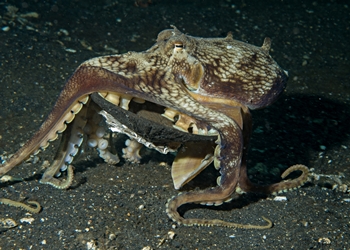 Coconut Octopus (Amphioctopus marginatus): Lembeh Strait, Sulawe- si, Indonesia: Photo: Colin Marshall (iNaturalist)
Enlarge Image! |
|
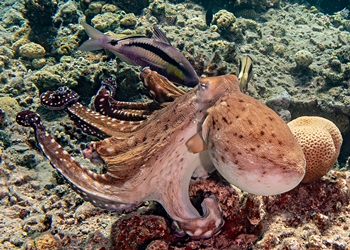 Day
Octopus (Octopus cyanea): Beersheba, Israel, Red Sea. Day
Octopus (Octopus cyanea): Beersheba, Israel, Red Sea.Photo: Jonigr (iNaturalist). |
BBC Earth:
Genius
Octopus Can Open Jars. (
YouTube Video).
Mark Rober:
Octopus vs
Underwater Maze. (
YouTube Video).
KPassionate:
Are
Whales, Dolphins, and Other Sea Creatures Using Tools? (
YouTube Video).
Octopuses are also known to use objects in their environment. Some species, such as the Coconut Octopus (Amphioctopus marginatus; image right), use coconut shells as portable shelters. Since the octopus not only hides beneath the shells but also actively transports them for later use elsewhere, scientists interpret this behaviour as a simple form of tool use.
Scinexx.de (2009) (German):
Oktopus trägt Kokosnuss-Schalen.
Another remarkable example comes from the Day Octopus or Big Blue Octopus (Octopus cyanea; image right), which has been observed cooperating with fish while hunting. These fish may indicate the presence of potential prey, particularly crabs and other crustaceans, or at least flush them from their hiding places. However, when a fish proves uncooperative, attempts to steal prey, or otherwise becomes a nuisance, the octopus may respond by delivering forceful blows with its arms in order to drive the fish away. Actually, Eduardo Sampaio and colleagues (2021) even suggested that some of these attacks might occasionally occur simply "out of spite". While perhaps less flattering, such behaviour would nevertheless constitute another indication of sophisticated cognitive abilities.
| |
|
BBC Earth:
Float Like
a Butterfly… Punch Like an Octopus? (
YouTube Video). |
| |
| SWR Kultur (German): Frank Wittig, Nina Kunze: Erstaunliches Teamwork: Kraken und Fische jagen gemeinsam. |
| |
| Sampaio, E.; Seco, M.C.; Rosa, R.; Gingins, S. (2021): Octopuses punch fishes during collaborative interspecific hunting events. Ecology 102 (3). (Link). |
Although the full extent of octopus intelligence remains far from completely understood, it is clear that a remarkable form of intelligence has evolved independently within the animal kingdom outside the vertebrates. At the same time, the achievements of squids and cuttlefish should not be overlooked. Many squids live and hunt in large schools, displaying complex collective behaviour patterns reminiscent of those seen in fish. Cuttlefish, meanwhile, have perfected the art of dynamic colour change, a phenomenon that can often be observed when individuals defend territories against rival cuttlefish or engage in social interactions.
DerStandard.at
(German): Karin Krichmayr:
Ist Oktopus-Intelligenz fundamental anders als unsere?
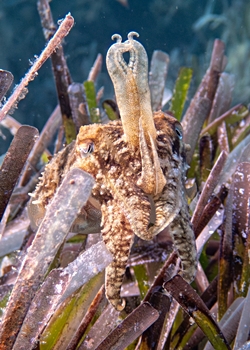 Common Cuttlefish (Sepia officinalis) with defensive posture. Photo: Falk Viczian (iNaturalist). |
On the other hand, cuttlefish and octopuses are noticeably less social: Outside of mating season (see below) they are rather solitary creatures, that will also vehemently defend their area against other of their kind. Especially remarkable also is the threat gesture of cuttlefish (see image left) when they have to defend against other cuttlefish. Changes of colour are then also applied: Octopuses, as well as cuttlefish, usually have a special colour pattern they display when they are aggressive.
All cephalopods have separate sexes. After a generally extensive mating ritual the male transfers sperm to the female in a spermatophora.
|
The Mystery of the Hectocotylus
The research history of the
hectocotylus is rather interesting: Although Aristoteles had described as early
as ca. 400 BC, that cephalopods had "a penis in one of their tentacles", at the
start of the 19th century various scholars described the hectocotyli of the
Paper Nautilus as parasitic worms living in the animal's mantle cavity. In 1829,
Cuvier even created the genus Hectocotylus for those "species of worms". |
see
Cephalopod Systematics!).
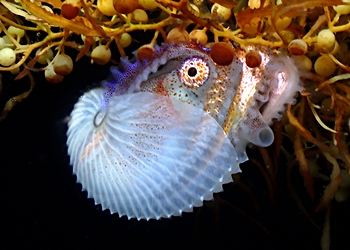
As a special feature in the Paper Nautiluses (Argonautidae), which are related to the octopuses, the hectocotylus separates from the male by autotomy and, then, attracted by chemical messengers, actively swims into the female's pallial cavity, where the copulation takes place without the male present. Nautiluses, on the other hand, have a specialised copulatory organ, called a spadix (Latin for spade), consisting of four tentacles molten together and located next to the mouth in midst of the about 90 remaining tentacles.
Generally, the hectocotyli are noticeably different from the remaining tentacles of the cephalopod: they carry less suckers and usually have a special form suitable for copulation. In squids and cuttlefish, the hectocotylus takes the spermatophora from the so-called Needham pouch, in octopuses it is loaded with a spermatophora by the male's penis.
Wikipedia:
Hectocotylus.
Hanlon,
R.T.; Messenger, J.B. (2018): Cephalopod
Behaviour. 2. Ed, S. 148 - 205. Cambridge University Press.
Additionally, in some cephalopods, such as the Paper Nautiluses (Argonautidae), a distinct sexual dimorphism is present, where the male is noticeably smaller than the female. Besides, only the females build the iconic shell-like eggcase (see picture right).
Robert Stansfield:
A crazy
night of argonauts. (Facebook Video).
OneBreathDiver Jules Casey:
Paper
Nautilus Rescue ( YouTube Video).
After leaving the oviduct, the female's eggs are fertilised. They are subsequently deposited either in clusters (cuttlefish and octopuses) or in gelatinous capsules or tubes (squids), each containing numerous eggs. The eggs are relatively large and rich in yolk. During embryonic development, cleavage is partial and discoidal, meaning that the embryo develops only on part of the yolk mass rather than dividing the entire egg. A substantial portion of the yolk often remains outside the embryo as an external yolk sac. While the developing embryo derives most of its nutrition from this external yolk reserve, part of the internal yolk sac generally remains available after hatching, sustaining the young cephalopod until it becomes capable of feeding on its own.
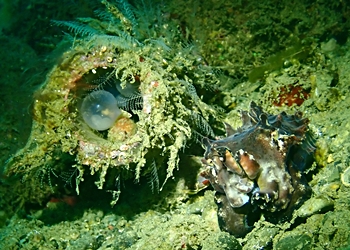 Flamboyant Cuttlefish (Ascarosepion pfefferi) next to its brood: Ambon, Maluku, Indonesia. Photo: Albert Kang (iNaturalist)
Enlarge Image! |
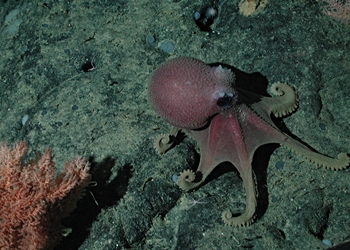 Deep Sea Octopus (Graneledone boreopacifica) on Davidson Deep Sea Mountain in 1970 m depth. Source: NOAA. |
Nature of
Things:
Mother
octopus makes the ultimate sacrifice for her babies. (
YouTube Video).
The Deep-sea Octopus (Graneledone boreopacifica) holds the record for the longest known period of maternal care. Females brood their eggs for up to four and a half years; a period of 53 months was documented by the Monterey Bay Aquarium Research Institute. This extraordinary brooding period occurs in the cold 7°C waters of the deep sea. The low temperatures result both in prolonged embryonic development and in a greatly reduced metabolic rate for the mother. Observations have shown that Graneledone boreopacifica females even refrain from feeding throughout the entire brooding period, despite food being offered to them during observations conducted with remotely operated vehicles.
| |
| Robison, B.; Seibel, B.; Drazen, J. (2014): Deep-Sea Octopus (Graneledone boreopacifica) Conducts the Longest-Known Egg-Brooding Period of Any Animal. (PLOS ONE 9/7, abgerufen: 05.05.2026). |
| |
|
MBARI Video:
Octomom: Deep-sea octopus guards her eggs for over four years. (
YouTube Video). |
A particularly unusual case is found among the Paper Nautiluses (Argonautidae). In these octopus-like cephalopods, the female produces a calcareous eggcase in which the developing eggs remain protected until hatching. Since Paper Nautiluses, unlike most octopuses, live epipelagically in the open ocean, the female can thus carry the brood with her rather than leaving it attached to a fixed substrate.
Squids and cuttlefish, by contrast, generally do not provide parental care, although some squid species carry their egg masses for a period of time. Others simply deposit the eggs and leave them unattended. Nautiluses likewise lay individual eggs and provide no further care.
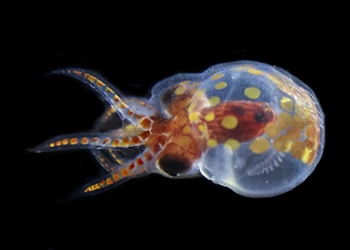 Paralarva of a Giant Pacific Octopus (Enteroctopus dofleini): San Juan Island, Washington, USA. Photo: J.A. Fields (iNaturalist).
Enlarge Image! |
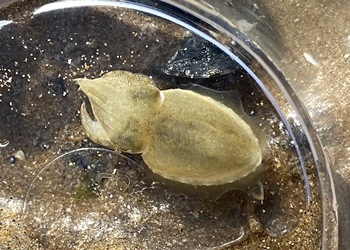 Juvenile Common Cuttlefish (Sepia officinalis), several days up to weeks old. Photo: Thomas Dreux (iNaturalist)
Enlarge Image! |
Most cephalopods are semelparous organisms. Semelparity describes a life-history strategy in which an organism reproduces sexually only once during its lifetime.
Wikipedia:
Semelparity and Iteroparity.
Cephalopods usually have a rather short life expectancy,even if they are not eaten by some predator before their time. Octopuses generally live for only one to a few years, while many cuttlefish and squids complete their entire life cycle within a single year. Given their limited lifespan, it is all the more remarkable that cephalopods are capable of developing such extraordinary behavioural and cognitive abilities. At the same time, their short generation times may contribute to their adaptability, potentially making many cephalopod species less vulnerable to human-induced environmental changes than numerous other groups of animals.
Spectrum.de Scilogs
(German): Gabriele Kerber (2020):
Tintenfisch statt Sprotten - Gewinner des Klimawandels.
Latest Change:
11.07.2026 (Robert
Nordsieck).
Latest Link Check: 24.05.2026.