
| Diese Seite auf Deutsch! |
|
Paper Nautiluses |
 Winged paper nautilus (Argonauta hians): Komodo, Indonesia. Photo: Bvanant (iNaturalist)  Enlarge Image!
 |
The paper nautiluses (Argonautidae) are a rather remarkable and curious family of cephalopods. The name "paper nautilus" might suggest that they are relatives of the chambered nautiluses (Nautilida), a very ancient group of cephalopods which, unlike most living cephalopods, still possess a coiled external calcareous shell and outwardly resemble fossil ammonites more than modern octopuses or squids. In Japanese, however, paper nautiluses are also known as Kaidako (貝蛸), which literally means "shell octopus".
|
According to MolluscaBase (2025), only four extant species of the family Argonautidae are recognised today, all belonging to the genus Argonauta, whereas all other genera and species are extinct. Fossil argonauts, however, are not easily found, probably because their delicate shell-like structure is too fragile to be readily preserved. Fossil remains are known from the Oligocene (approximately 23 - 34 million years ago; see geological timescale), but are particularly known from Miocene deposits (approximately 5.3 - 23 million years ago) in Japan, Cyprus and Styria (Austria).
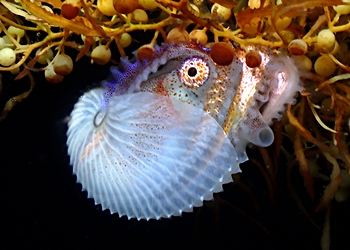 Female Greater Paper Nautilus (Argonauta argo): Teneriffa, Canary Islands. Photo: Marc Martin Sola (iNaturalist).
Enlarge Image! |
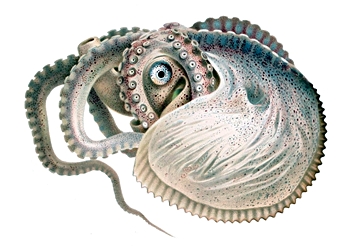 Drawing of a paper nautilus by C. Merculiano in Jatta, G. (1896): "I Cefalopodi viventi nel Golfo di Napoli". (Link, Source). |
Paper nautiluses exhibit pronounced sexual dimorphism: while the female may grow to a body length of up to 10 cm, the male rarely exceeds 2 cm. Only the female produces a shell-like structure, constructing an eggcase of up to 7 cm shortly before reaching sexual maturity, which serves as a container for her eggs. Males, by contrast, do not produce such a structure. The Greater Paper Nautilus can be distinguished from other paper nautilus species by the characteristic bluish colouration of the two anterior arms and the area surrounding the eyes. In addition, the shape and surface structure of the eggcase are commonly used for species identification.
Argonauta argo belongs to the octopuses (Octopoda), as indicated by the presence of eight arms, each bearing two rows of suckers. This contrasts, for example, with a nautilus, which possesses a much larger number of appendages (up to 90), but these lack suckers. The paper nautilus is a pelagic cephalopod, unlike most of its octopus relatives, which primarily inhabit the ocean floor. It is now assumed that paper nautiluses diverged relatively early in their evolutionary history from the remaining predominantly benthic octopuses (Octopoda). They may therefore have retained certain ancestral features of early octopus lineages. Further clarification is expected from DNA studies.
The scientific name Argonauta derives from Greek mythology. The legend of the Argonauts tells of a group of Greek heroes, led by Jason, who set out in search of the Golden Fleece in Colchis in the Caucasus, travelling aboard the exceptionally swift ship Argo. Until the 19th century, it was believed that the specially modified arms of the female argonaut functioned as sails, allowing the animals to move with the aid of the wind in a manner somewhat similar to the Portuguese man o'war (Physalia physalis). However, unlike the mythical Argo, the sail-like arm ends of the female argonaut do not serve locomotion. Instead, they are used in the construction of the eggcase through glandular cells located in them.
Bizarre Beasts:
The Only
Octopus With a Shell. ( YouTube Video).
Em Gems:
The Paper Nautilus, An Octopus in Disguise. (
YouTube Video).
YouTube Video).
Em Gems:
The Paper Nautilus, An Octopus in Disguise. (
YouTube Video).
Sea Change:
Argonaut
Encounter. (
YouTube Video).
|
Who Was Jeanne Villepreux-Power? The French naturalist Jeanne Villepreux-Power
(1794–1871) studied the local flora and fauna during the years she lived in
Sicily. |
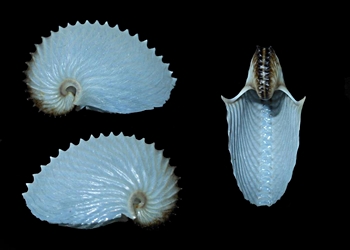 Egg case of the Greater Paper Nautilus (Argonauta argo): Milazzo, Mes- sina, Sicily, Italy. Photo: Andrea Ruggieri (iNaturalist)
Enlarge Image! |
||
One small specimen of Argonauta argo was observed carrying 48,800 embryos within an eggcase measuring only 88 mm in length. The largest known eggcase of Argonauta argo, however, has been measured at 300 mm, although such dimensions may represent exceptional cases. The eggcases of argonauts are relatively variable in form, which historically led to the description of numerous additional species. These are now regarded as junior synonyms, leaving only four extant species recognised today.
 |
| Okutani, T.; Kawaguchi, T. (1983): "A mass occurrence of Argonauta argo (Cephalopoda: Octopoda) along the coast of Shimane Prefecture, Western Japan Sea". Venus 41: p. 281 - 290. |
In addition, female argonauts are capable of repairing damage to the eggcase. Unlike the shells of molluscs such as bivalves or snails, the eggcase is not permanently attached to the soft body. Whereas shells in these groups are connected through retractor or adductor muscles, the female argonaut instead holds the eggcase using several of her arms. The eggcase of paper nautiluses is also composed of calcite rather than aragonite. Furthermore, unlike the shell of a nautilus, it is not chambered. Nor does the eggcase play any direct role in locomotion.
Although air is enclosed within the upper part of the eggcase and contributes to buoyancy, and it has been suggested that the female may replenish this air reserve at the water surface when necessary, no gas exchange takes place between the soft body and the eggcase. Instead, the paper nautilus moves by means of the jet propulsion mechanism typical of most cephalopods, expelling water from the mantle cavity through the funnel. The characteristic shape and surface structure of the eggcase may help improve hydrodynamic properties; it has also been suggested that the eggcase may provide some protection against ultraviolet radiation from sunlight, to which argonauts, unlike their benthic relatives, are exposed to a greater degree.
The eggcase of the paper nautilus is therefore not homologous to the true shell of molluscs, but rather represents a completely different and independently evolved structure with a different function: protecting the eggs rather than the animal itself. Since it is not attached by retractor muscles, the animal is also able to leave the eggcase if necessary.
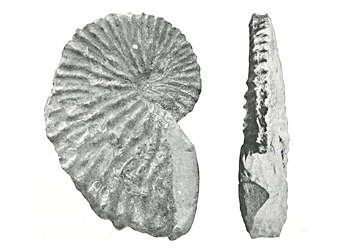 Argonauta joanneus, a fossil Argonaut from the Miocene of Styria (Austria). Source: Hilber, V. (1915). |
| |
| Hilber, V. 1915: "Der älteste bekannte und erste miozäne Argonauta". Mitteilungen des naturwissenschaftlichen Vereins für Steiermark 51: 107–110. (PDF). |
| |
| Martill, D.M.; Barker, M.J. (2006): "A Paper Nautilus (Octopoda, Argonauta) From the Miocene Pakhna Formation of Cyprus". Palaeontology, Vol. 49, Part 5, S. 1035 - 1041 (PDF). |
| |
| Saul, L.R.; Stadum, C.J. (2005): "Fossil Argonauts (Mollusca, Cephalopoda, Octopodida) From the Late Miocene Siltstones of the Los Angeles Basin, California". Journal of Paleontology, 79 (3): S. 520 - 531 (2005). (Link). |
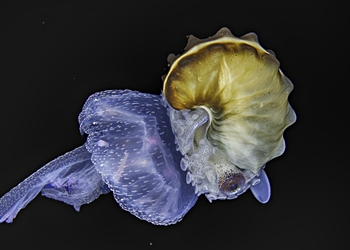
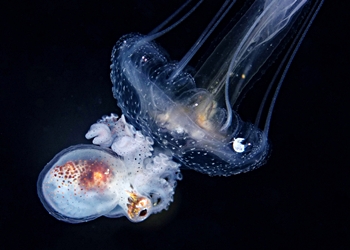 Winged Paper Nautilus (Argonauta hians, presumably juvenile female without shell) on a pelagic jellyfish: Mabini, Batangas, Philippines. Photo: Xenomatt (iNaturalist)
Enlarge Image! |
In the open ocean, argonauts have occasionally been found associated with jellyfish. The animals do not simply consume the jellyfish itself; rather, they may bore into its body and feed on food particles present within the jellyfish's stomach. It has also been suggested that the argonaut may use the jellyfish for camouflage, defence, and perhaps even as a means of transport.
Heeger,
T.; Piatkowski, U.; Möller,
H. (1992): "Predation on jellyfish by the cephalopod
Argonauta argo". Marine Ecology Progress Series. 88: S. 293 - 296. (PDF).
Robert Stansfield:
A crazy
night of argonauts. (Facebook Video).
Observations of female Argonauta argo in captivity have shown that the animals also employ their sail-like expanded arm tips during feeding. When prey comes into contact with these modified arms, it is rapidly seized by one of the remaining arms (Norman, 2000).
Along the coasts of South Africa and Australia, mass strandings of abandoned argonaut eggcases occasionally occur. These events are seasonal and generally take place between April and August, towards the end of the breeding season, presumably after the adult animals have died following the hatching of the young.
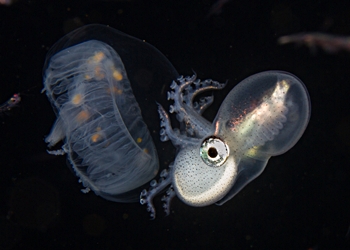 Argonauta nodosus, male with visible hectocotylus. Northland, New Zealand. Photo: Paul Craiger (iNaturalist)
Enlarge Image! |
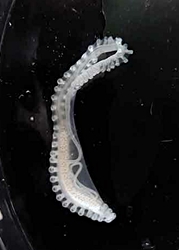 Hectocotylus of Argonauta argo. Source: Battaglia et al. (2021). |
Unlike other cephalopods, however, the male argonaut detaches the hectocotylus during copulation (autotomy), after which it is capable of finding its own way into the mantle cavity of the female. Since no male argonauts with regenerated hectocotyli have ever been found, this suggests that the male probably dies after mating.
This also explains why Georges Cuvier, who discovered such a structure within the mantle cavity of a female argonaut, initially described it in 1829 as a separate species. The true nature of the hectocotylus was only understood several years later.
| |
| Battaglia, P.; Stipa, M.G.; Ammendolia, G.; Pedà, C.; Consoli, P.; Andaloro, F.: Romeo, T. (2021): "When nature continues to surprise: observations of the hectocotylus of Argonauta argo Linnaeus, 1758". The European Zoological Journal, 88 (1), 980 - 986. (Link). |
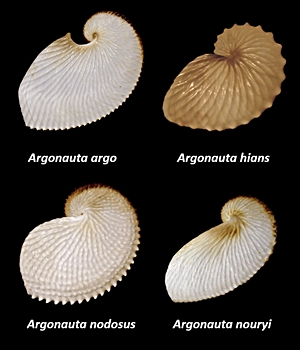 The four presently valid extant species of the Argonauta genus. (Source, modified and corrected).
Enlarge Image! |
The four currently recognised living species of the genus Argonauta are:
Wikipedia).
Wikipedia).
Wikipedia).
Wikipedia).
Latest Change:
12.07.2026 (Robert
Nordsieck).
Latest Link Check: 24.05.2026.
