
| Diese Seite auf Deutsch! |
|
Giant OctopusesEnteroctopodidae Strugnell et al., 2014 |
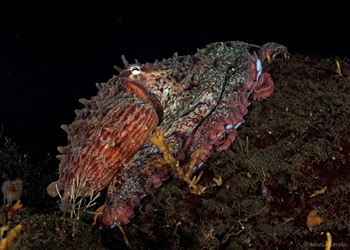 Giant Pacific Octopus (Enteroctopus dofleini): Hoodsport, Washing- ton, USA. Photo: Amelia Serafin (iNaturalist)  Enlarge Image!
 |
| Part 1 | Part 2 |
Part 3
 |
Part 4 |
|---|---|---|---|
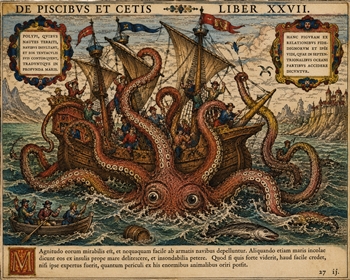 A kraken attacks a sailing ship, as envisioned by Olaus Magnus and Conrad Gesner. AI Illustration: Robert Nordsieck.
Enlarge Image! |
|
Cephalopods in Myths and Legends.
The largest octopuses living on Earth today are, however, considerably smaller and by no means capable of attacking sailing ships. Nevertheless, the giant octopuses include the largest octopus species living today, the Giant Pacific Octopus (Enteroctopus dofleini).
Adult individuals normally grow to a weight of around 15 kg and a maximum arm span of more than 4 m. The largest measured specimen reportedly weighed as much as 270 kg and sported an arm span approaching 10 m. The Giant Pacific Octopus is one of the best-known cephalopod species of North America and has become particularly famous because it is commonly kept in many aquaria along the western coast of North America. In addition, it plays a significant role in fisheries and in local culture.
While the Giant Pacific Octopus occurs along the coasts of the North Pacific - from Baja California along the western coast of North America to Alaska and the Aleutian Islands in the north, and along the north Pacific coasts of Asia from Korea via China and Japan to Kamchatka and the Sea of Okhotsk - other species of giant octopuses are also found in other parts of the world. The Southern Red Octopus (Enteroctopus megalocyathus), for example, lives near the coasts of southern South America; the South African Giant Octopus (Enteroctopus magnificus) inhabits parts of the South African coast; and the New Zealand Giant Octopus (Enteroctopus zealandicus) is found in the waters around New Zealand.
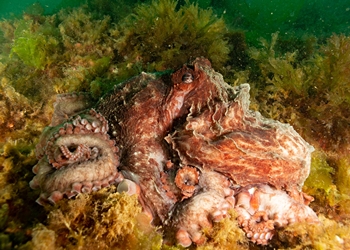 Southern Red Octopus (Enteroctopus megalocyathus): Pardelas, Golfo Nuevo, Argentinia. Photo: Gonzalo Bravo (iNaturalist)
Enlarge Image! |
Only in 1998 did anatomical studies reveal that various features, including the structure of the gills, differed sufficiently from those of other octopuses such as the Common Octopus (Octopus vulgaris) to justify placing the species within the genus Enteroctopus. This genus now also includes the other giant octopus species mentioned above. Since 2014, these species have been placed within the family Enteroctopodidae, together with other species such as the deep-sea hydrothermal vent octopus Vulcanoctopus hydrothermalis (see Cephalopod Systematics).
 |
| MolluscaBase: Enteroctopodidae Strugnell, Norman, Vecchione, Guzik & Allcock, 2014. |
| |
| MolluscaBase: Enteroctopus dofleini (Wülker, 1910). |
| |
|
Wikipedia:
Giant Pacific Octopus. |
| |
| Gabb, G. (1862): Descriptions of two new species of Cephalopodes in the Museum of the California Academy of Natural Sciences. Proceedings of the California Academy of Natural Sciences. 2: S. 170-172. (Link). |
| |
| Wülker, G. (1910): Über japanische Cephalopoden: Beiträge zur Kenntnis der Systematik und Anatomie der Dibranchiaten. Bd. 3: 1, S. 7 f. Verlag der K.B. Akademie der Wissenschaften, München. (Link). |
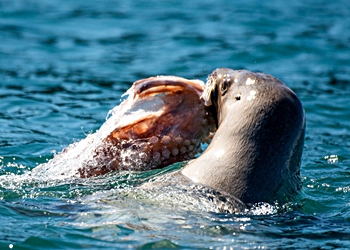 Steller Sea Lion (Eumetopias jubatus) feeding on a Giant Pacific Octopus: Elfin Cove, Alaska, USA. Photo: Kim Nesbitt (iNaturalist)
Enlarge Image! |
Gayne C. Young (Outdoor
Life):
Pacific Octopus Eats Seagull.
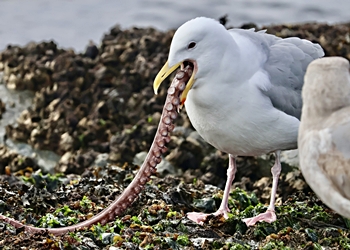 A gull eating the tentacle of a Giant Pacific Octopus: Victoria, British Co- lumbia, Canada. Photo: Kelpadelpian (iNaturalist)
Enlarge Image! |
Throughout its range, the Giant Pacific Octopus is usually found from the intertidal zone down to depths of approximately 2,000 metres, particularly in colder waters rich in oxygen and nutrients. Like other octopuses, it possesses two distinct methods of locomotion. Rapid swimming is achieved by means of the jet propulsion system typical of cephalopods: the octopus expels water from the mantle cavity through the funnel and is thereby propelled backwards. During this movement it swims with the body leading and the arms trailing behind (see above). Along the ocean floor, however, it moves more slowly by "walking" across the substrate using its arms. At the same time, it actively explores its surroundings. Sensory cells arranged around the suckers provide additional information related to smell and taste. Since each arm contains its own nerve centre, or ganglion, the arms can also operate independently to a certain extent (see nervous system). In large Giant Pacific Octopuses, these suckers may exceed 6 cm in diameter and can support weights of up to 16 kg.
Cosgrove,
James; McDaniel, Neil: "Super Suckers: The Giant Pacific Octopus and Other
Cephalopods of the Pacific Coast". Harbour Publishing, Pender Harbour, BC, 2009.
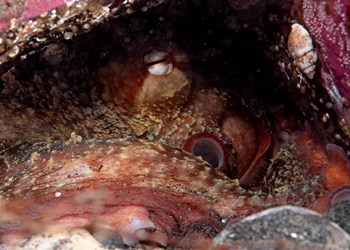 A Giant Pacific Octopus in its lair: Puget Sound, Washington, USA. Photo: Daniel Hershman (iNaturalist)
Enlarge Image! |
Giant octopuses are relatively sedentary and usually retain the same shelter for as long as possible, moving only when necessary and often only a few metres away. Such movements may occur when food resources become insufficient or when oxygen levels in the water decline, for example as a result of eutrophication and algal blooms. In addition, the Giant Pacific Octopus appears to prefer water temperatures between 8 and 12 °C, meaning that climatic changes may also lead the animals to migrate into deeper and colder waters.
Monterey Bay
Aquarium:
Giant Pacific Octopus.
While most octopus species live for only a single year, Giant Pacific Octopuses may reach an age of three to five years and become sexually mature at around two years of age. To compensate for their comparatively short lifespan, Giant Pacific Octopuses produce very large numbers of eggs: a female may lay between 120,000 and 400,000 eggs. Mating takes place by means of the hectocotylus, a specialised arm with which the male transfers a very large spermatophore into the mantle cavity of the female. The female stores the spermatophore in a structure known as the spermatheca until she is ready for fertilisation. In one female at the Seattle Aquarium, an interval of approximately seven months was observed between mating and the deposition of fertilised eggs.
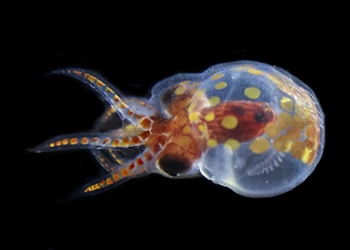 Paralarva of a Giant Pacific Octopus (Enteroctopus dofleini): San Juan Island, Washington, USA. Photo: J.A. Fields (iNaturalist).
Enlarge Image! |
| |
| Anderson, R.C.; Wood, J.B.; Byrne, R.A. (2002): "Octopus Senescence: The Beginning of the End". Journal of Applied Animal Welfare Science. 5 (4): 275 - 283. (Abstract). |
The paralarvae of the Giant Pacific Octopus are approximately the size of a grain of rice at hatching and weigh only about 0.03 g. However, they grow extremely rapidly: up to around two years of age they may increase their weight by approximately 0.9% per day, eventually reaching a body mass of around 20–40 kg. Until then, however, they form part of the diet of numerous plankton-feeding and filter-feeding animals, and only a very small proportion survive the juvenile stage. The growth and maturation of octopuses are strongly influenced by water temperature. While individuals in colder waters develop more slowly, those in warmer waters grow faster, although this may reduce their lifespan by as much as 20%.
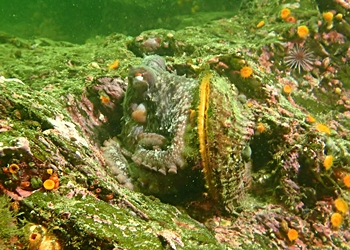 Giant Octopus hiding behind a scallop: Alexander Archipelago, Alaska, USA. Photo: Madison Reynolds (iNaturalist).
Enlarge Image! |
Octopuses are generally considered to be the most intelligent invertebrates. The Giant Pacific Octopus in particular is frequently kept in aquaria and zoological collections along the western coast of North America because its large size makes it easy to observe and highly attractive to visitors. Giant Pacific Octopuses have, for example, been observed recognising particular individuals and responding to them through changes in colour, body posture and behaviour, including squirting water from the funnel. There is even evidence suggesting that octopuses possess distinct personalities. Giant Pacific Octopuses can also open containers, including those fitted with child-proof mechanisms, in order to gain access to their contents. Similar to the Coconut Octopus (Amphioctopus marginatus), giant octopuses may collect and use objects as shelter or protection (see: Intelligence Outside of Vertebrates?).
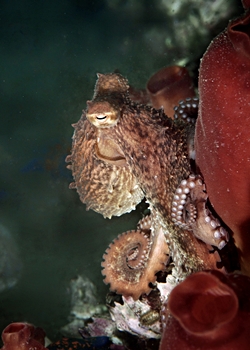 Giant Pacific Octopus: Andreevka, Vladivostok, Russia. Photo: Elena Kushkhova (iNaturalist). |
The effects of human activities on giant octopuses are varied. Because of their relatively sedentary lifestyle, Giant Pacific Octopuses are particularly affected by changes in the properties of the surrounding water. These include oxygen and nutrient levels, water temperature, and especially water acidity (pH), which may have strongly negative effects on octopuses.
The availability of prey may be heavily influenced by fishing activities and changes in water quality. On the other hand, reductions in predator populations caused by fishing may temporarily benefit octopus populations. However, this may in turn lead to increased competition for food among octopuses themselves, with the additional complication that octopuses are also targeted by fisheries. Since many prey animals of octopuses, including crustaceans, bivalves and snails, tend to accumulate pollutants within their tissues, which may, as a consequence, also negatively affect the health of octopus populations.
The Giant Pacific Octopus is currently classified by the IUCN as "Least Concern". In some regions, local initiatives exist to restrict Giant Octopus fisheries to some extent. These efforts are largely driven by the popularity and public recognition of the Giant Pacific Octopus. Likewise, concerns are frequently raised regarding the keeping of octopuses in aquaria, since some consider this to represent an unacceptable treatment of an obviously intelligent animal.
| |
|
BBC Earth:
Genius
Octopus Can Open Jars. ( YouTube Video).
 |
| |
|
Monterey Bay Aquarium:
Stuck
on you: caring for our giant Pacific octopus. (
YouTube Video). |
| |
|
OctoNation:
Playing with Godzilla, the Giant Pacific Octopus at Aquarium of the Pacific!.
(
YouTube Video). |
| |
| Anderson, R.C.; Mather, J.A.; Monette, M.Q.; Zimsen, S.R.M. (2010): "Octopuses (Enteroctopus dofleini) Recognize Individual Humans". Journal of Applied Animal Welfare Science. 13 (3): S. 261 - 272. (Abstract). |
| |
| Mather, J.A.; Kuba, M.J. (2013): "The cephalopod specialties: complex nervous system, learning and cognition". Canadian Journal of Zoology. 91 (6): S. 431 - 449. (Abstract). |
| |
| Mather, Jennifer A.; Anderson, Roland C.; Wood, James B.: "Octopus: The Ocean's Intelligent Invertebrate ". Timber Press, Portland, 2010. (Link). |
| |
| Monterey Aquarium: The Giant Octopus Exhibit. |
Van Pelt, Shelby:
"Remarkably Bright Creatures". A Novel. Ecco Publishing, New York, 2025. (Link).
Now a movie at
Netflix
(2026).
Latest Change:
12.07.2026 (Robert
Nordsieck).
Latest Link Check: 24.05.2026.
