
| Diese Seite auf Deutsch! |
|
Nautiloids: The Fossil History |
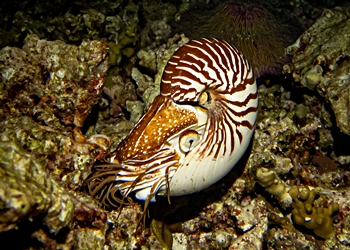 Nautilus macromphalus: Lifou, New Caledonia, Pacific. Photo: Pauline Fey (iNaturalist).  Enlarge!
 |
| Part 1 | Part 2 |
Part 3
 |
Part 4 |
|---|---|---|---|
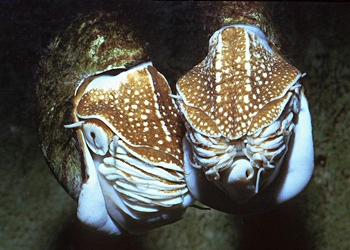 Nautilus pompilius. Photo: Vladimír Motyčka (biolib.cz). |
What is the Meaning of "Nautiloids"? Except in scholarly scientific publications, generally all cephalopods in the evolutionary path since the Ellesmeroceratida are referred to as Nautiloidea, finally having led to the evolution of the extant nautiluses (Nautilidae) living today. Usually not a part of this are groups like the Ammonoidea, as well as the Coleoidea, the latter also containing the shell-less Cephalopods of today. From a scientific viewpoint, this is not correct, since this also includes group that are not ancestors of today's Nautilidae. Thus, on the present page the path will be described that has led to the evolution of today's nautiluses since the Cambrian. The earliest fossils of the true Nautiloidea s.str. as the subclass those belong to, have only been found from the Devonian period, ca. 400 Mio. years ago (mya). |
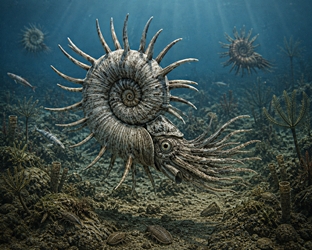 Reconstruction of a nautiloid from the Permian (ca. 250 - 290 mio. years ago). AI Illustration: Robert Nordsieck.
Enlarge! |
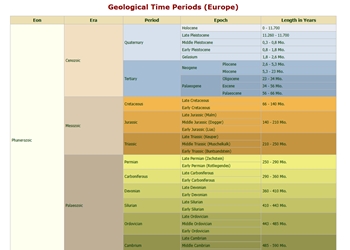 Geological Time Periods (Europe): mya = Million years ago. |
So the assumption could be made that nautiluses are the ancestors of the modern cephalopods (Coleoidea). Ammonites and belemnites, the best-known shelled cephalopods of the fossil record, would then appear to be their extinct relatives.
However, the reality is considerably more complex: The chambered nautiluses living today and their relatives are not exactly ancestors of the other living (extant) cephalopods. Rather, they share common ancestors with them, provided one looks far enough back into geological history. In fact, the modern chambered nautiluses (Nautilidae) themselves are not exactly ancient: their fossils are only known from the Palaeogene. Their evolutionary lineage, however, from which they have retained many ancestral features, extends noticeably further back, into the very earliest eras of of cephalopod palaeontological history .
The situation is further complicated by the fact that the ancestors of modern nautiluses are commonly referred to as nautiloids. Exactly which groups are included within this term remains a matter of debate: By the most widely used term, the nautiloids comprise the ancestral groups and the evolutionary lineage leading from them to the modern Nautilidae, but not the branches which eventually led to the evolution of the modern Coleoidea and the extinct Ammonoidea.
Strictly speaking, a new term should probably be coined for these early
cephalopod groups, since the true nautiloids are more closely related to modern
cephalopods like the Coleoidea than they are to the earliest known cephalopods,
the Plectronoceratida (see below) (cf. Pohle
et al., 2024, pp. 36 ff.). In addition, the term Nautiloidea is used twice in
cephalopod systematics: once for the subclass of the Cephalopoda that includes
the Nautilidae, and again for the superfamily which the Nautilidae are a part of
as well (
vgl.
Cephalopod Systematics).
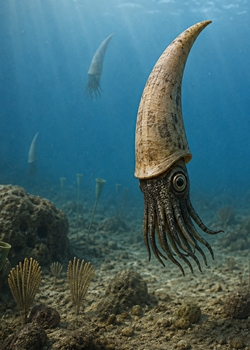 Plectronoceras cambria from the late Cambrian. AI Illustration: R. Nordsieck.
Enlarge! |
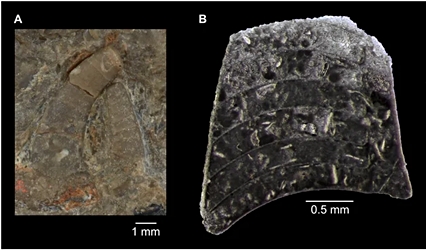 Fossils of Plectronoceras cambria from the Ptychaspis-Tsinania zone in Yenchou (China). Source: Pohle, A. et al. (2024) (Link). |
By increasing the salt concentration of its blood, the animal created an osmotic gradient that caused water to diffuse from the chambers' contents into the bloodstream, while in return, gas diffused from the blood back into the chambers. Unlike their bottom-dwelling relatives, the resulting buoyancy allowed animals such as Plectronoceras to hover in the water column. The chambered shell of the modern nautilus still operates according to the same principle today.
There is, however, no complete agreement on how these early cephalopods used their chambered shell, or phragmocone. Fossils of Plectronoceras cambria (see picture on the left) show the animal only reached a few millimetres in size. Most specimens have been recovered from the Fengshan Formation of present-day northern China and the Ninmaroo Formation of Queensland, Australia (cf. Pohle et al, 2024), with additional finds reported from southern China, Kazakhstan and Siberia. Although, thus far, only fragments of the shells have been found, they clearly show that the shell was chambered and that the animal already possessed a siphuncle (see above).
Since then, several theories have been proposed as to how these animals moved through the seas of the Late Cambrian. One hypothesis suggests that they drifted through the water much like modern jellyfish, using their buoyant shells while capturing plankton with their arms. Another proposes that they were primarily crawling animals living on the sea floor, using the buoyancy of their shells to make short hops when escaping from danger (cf. Pohle et al., 2024, p. 36).
In later nautiloids of the Ordovician (see below), the weight of the soft body was balanced by calcareous deposits known as endocones at the posterior (adapical) end of the shell, allowing the animals to maintain a horizontal swimming position (see Endocerates).
 |
|
Pohle, A.; Jell, P.; Klug, C. (2024): Plectronoceratids (Cephalopoda) from the latest Cambrian at Black Mountain, Queensland, reveal complex three-dimensional siphuncle morphology, with major taxonomic implications. PeerJ 12. (Link). |
The Cambrian Period, however, ended with a global
extinction event. About 510 million years ago, only some five million years
after the first cephalopods had appeared in Earth's oceans, a major glaciation
began. A large proportion of the established animal species, including apex
predators such as Anomalocaris canadensis (
Picture by Nobu Tamura), became extinct either during the glaciation as a
result of falling sea levels and then again later, when melting glaciers
released freshwater into the sea, thus diluting the sea water and altering the
salinity of the oceans.
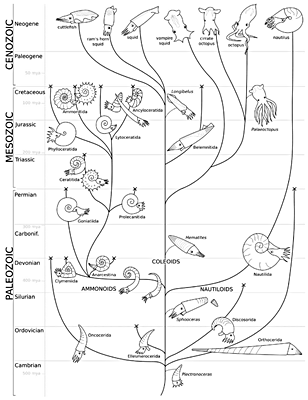 The Evolution of Cephalopoda according to Staaf (2017).
New Window! |
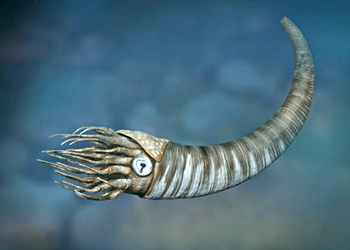 Cyrthoceratites sp., a fossil Nautiloid from the middle Ordovician to the middle Devonian (ca. 470 - 370 mya). Picture: Nobu Tamura (Source). |
Particularly striking is the extraordinary diversity of shell forms that
appeared during this period. A basic distinction can be made between slightly
curved cyrtoconic shells (see image right) and straight orthoconic shells. These
can in turn be divided into short-shelled breviconic forms and elongated
longiconic forms.
Nautiloid Shell Shapes.
Geo Girl:
Mollusca
(Pt 3)- Cephalopods- Invertebrate Paleontology. ( YouTube Video).
The coiled shells of today's living nautilids are descended from the last surviving order of the Nautiloidea, which originated during the Late Devonian ca. 400 million years ago. However, nautiloid groups with coiled shells had already appeared much earlier, during the Silurian. There is no clear evolutionary transition from straight to coiled shells, as both forms existed side by side, and fossils with straight orthoconic shells can still be found as late as the Triassic (see below).
| |
|
Flower, R.H. (1964). The nautiloid order Ellesmeroceratida (Cephalopoda). State Bureau of Mines and Mineral Resources New Mexico Institute of Mining and Technology, Memoir. 12: 1-234. (PDF). |
| |
|
MolluscaBase (2025): Ellesmeroceratida †. |
Over the course of the Ordovician, the Ellesmeroceratida gave rise to several orders of shelled cephalopods that successfully adapted to a wide range of marine habitats.
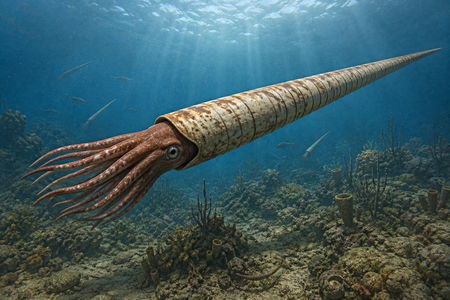 A large Endocerate in its natural habitat during the Ordovician of Kentucky, USA. AI Illustration: Robert Nordsieck.
Enlarge! |
|
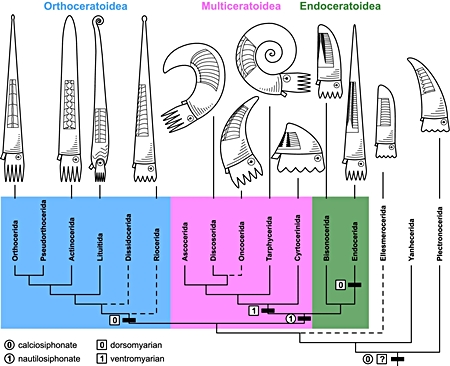 Simplified phylogram of early palaeozoic cephalopod evolution. Source: Pohle, A. et al. (2022), Fig. 9. (Link).
Enlarge! |
Phylogenetic studies (see phylogram below right) have shown that a major diversification occurred within the Ellesmeroceratida during the Ordovician. Three principal subclasses emerged: the Endoceratoidea, Multiceratoidea and Orthoceratoidea. From within the latter lineage evolved the Bactritida and, ultimately, the Coleoidea: the shell-reduced "advanced" cephalopods of today, including cuttlefish, squids and octopuses.
| |
|
King, A.H.; Evans, D.H. (2019): "High-level classification of the nautiloid cephalopods: a proposal for the revision of the Treatise Part K". Swiss Journal of Palaeontology 138, 65 - 85 (2019). (Link). |
| |
|
Pohle, A.; Kröger, B.; Warnock, R.C.M. et al. (2022): "Early cephalopod evolution clarified through Bayesian phylogenetic inference". BMC Biology 20, 88. (Link). |
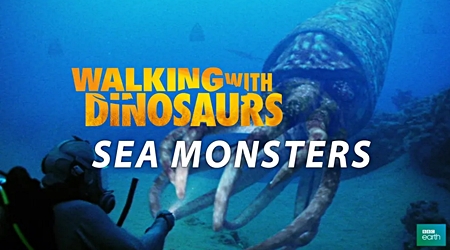 The title of the "Walking with Dinosaurs - Sea Monsters" 2003 TV series with Nigel Marven. In the ordovician sea in the region of today's New York, Nigel Marven encounters Camero- ceras, a giant Endocerate. (Source). |
Giant endocerates are rather rarely found in the fossil record: The distinct majority of orthocone nautiloids are noticeably smaller, most are less than a metre long.
| |
|
Klug, C.; Fuchs, D.; Pohle, A. et al. (2025): "Cephalopod body size and macroecology through deep time". Scientific Reports 15, 30736. (Link). |
| |
|
Teichert, C.; Kummel, B. (1960): "Size of Endocerid Cephalopods". Breviora 128: 1 – 7. (Link). |
Due to its size, Cameroceras trentonense (named after the Trenton Limestone Group in the USA, where it had been found in 1842) even earned a role in Nigel Marven's 2003 TV series "Sea Monsters" (Folge 1: "Dangerous Seas"). Likewise, it is described in the 2023 Netflix series "Life on Our Planet" , episode 2 "The First Frontier".
Marven, N.; James,
J.: "Monster der Tiefe - Im Reich der Urzeit", Egmont-VGS Verlag Berlin, 2004. (Link).
"Life
on Our Planet", Episode 2: "The
First Frontier" on Netflix.
Dinopedia:
Cameroceras.
Fossils of not only Cameroceras also are remarkable for their so-called endocones: Funnel-shaped calcareous deposits stacked in the rear (adapical) part of the siphuncle channel, which can be very wide, about half of the overall shell diameter. Also the siphuncle channel, positioned near the chambers' wall, is encased by calcerous, so-called septal necks (see phylogram on the right: "calciosiphonate").
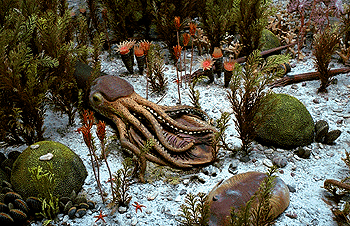 A diorama from the Ordovician: An Endocerate (Cameroceras) feeding on a trilobite. Note: Endocerates most likely had no sucker cups on the tentacles, since neither do today's Nautilids. Picture: Carl Wozniak, Uni. Mich. Museum of Natural History. |
In the modern nautilus, the siphon (hyponome) is much simpler in structure than that of the Coleoidea. It consists of a fleshy tube formed by two rolled folds of tissue. This simplicity suggests that it may represent the ancestral condition, although simpler structures are not always necessarily primitive. It is therefore plausible that the smaller nautiloids of the Ordovician were relatively efficient and agile swimmers. Since modern nautiluses can move slowly forwards by directing the hyponome backwards, fossil nautiloids, too, may have used two methods of locomotion: slow forward movement during normal activity and rapid backward propulsion to escape from predators.
The larger species, such as the giant endocerates, were probably considerably less manoeuvrable because of the weight of their shells. Earlier studies therefore commonly assumed that these enormous animals spent much of their time resting on or near the sea floor while searching for prey (see image left). However, more recent hydrostatic models (Peterman et al., 2019, 2021), suggest that large straight-shelled (orthoconic) nautiloids such as Cameroceras typically adopted a near-vertical orientation in the water column when at rest. This interpretation is also presented in the second episode, "The First Frontier", of the television series "Life on Our Planet". Such a posture may have enabled Cameroceras to move vertically through the water column and to adjust its depth spending a relatively little amount of energy.
The function of the characteristic "endocones" (see above) within the large siphuncle of the endocerids remains a matter of scientific debate: In addition to providing mechanical reinforcement for the shell, they may have served to functionally isolate the posterior part of the siphuncle from the anterior part. At the same time, these calcareous deposits shifted weight towards the rear (adapical) part of the shell. So, some researchers suggest that the endocones played a role in maintaining hydrostatic stability. However, s Cameroceras is known only from its shell - in many cases even only from fragments - its lifestyle and hunting behaviour do remain the subject of ongoing scientific discussion.
| |
|
Peterman, D.J.; Barton, C.C.; Yacobucci, M.M. (2019): "The hydrostatics of Paleozoic ectocochleate cephalopods (Nautiloidea and Endoceratoidea) with implications for modes of life and early colonization of the pelagic Zone". Palaeontologia Electronica. (Link). |
| |
|
Peterman, D.; Ritterbush, K. (2021): "Vertical escape tactics and movement potential of orthoconic cephalopods". PeerJ 9, e11797. (Link). |
During the Ordovician into the Silurian, trilobites were by far the most abundant arthropods. The time of highest species richness in nautiloids and trilobites thus appears the be the same. Thus it is highly unlikely that there was not a predator-prey-relationship between the two groups, also taking into account that modern cephalopods to a large extent rely upon crustaceans and other arthropods for food, and also that the large cephalopods fo the Ordivician probably were not very capable swimmers. However, they were not the only large predators of the Ordovician, since that was also the time of large sea skorpions (Eurypterids).
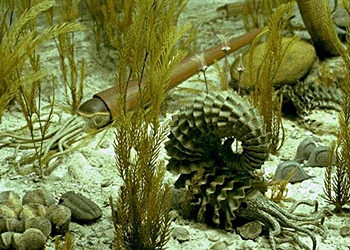 Goldringia (a Nautiloid, in front) and Michelinoceras (behind) during the Devonian. Picture: Carl Wozniak, Uni. Mich. Museum of Natural History. |
Many other cephalopod groups, however, survived the transition into the following Silurian era. Some, including the Tarphyceratida, Discosorida, Oncoceratida and Orthoceratida, persisted even as long as into the Devonian.
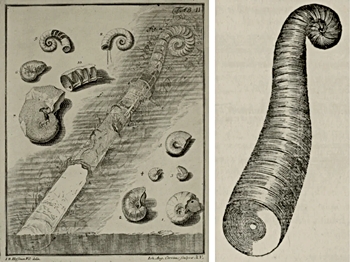 Historical illustration of Lituites ("Bishop's staff"). The creature begins with a coiled shell and then continues in straight way. Source: Aubrechtova, M.; Korn, D. (2022) (
Enlarge!). |
|
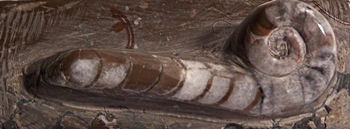 Fossil of Lituites from Hunan Province (China). (Source). |
Researchers from earlier times, most notably Schindewolf (1942), had proposed that the Nautilida evolved from straight-shelled (orthoconic) ancestors through intermediate forms such as Lituites (see images right), which had first appeared during the Ordovician. We know today, however, that Lituites and the Lituitidae rather were derived members of the Tarphyceratida and so belonged to an entirely different branch of fossil cephalopods (see phylogram upper right).
Overall, the Silurian and Devonian witnessed a gradual decline in cephalopod diversity. The most likely explanation is the increasing competition from other animal groups that had evolved by the time.
| |
|
Kummel, B. (1964): "Nautilida" in Treatise on Invertebrate Paleontology, Part K. Mollusca 3. (Geological Society of America, and University of Kansas Press). (PDF, Ch. 2, S. 105 ff.). |
| |
|
Teichert, C. (1988). "Main Features of Cephalopod Evolution". In Clarke, M.R.; Trueman, E.R. (eds.). Paleontology and Neontology of Cephalopods. The Mollusca. Vol. 12. Academic Press. |
| |
|
Aubrechtova, M.; Korn, D. (2022): "Taxonomy and ontogeny of the Lituitida (Cephalopoda) from Orthoceratite Limestone erratics (Middle Ordovician)". European Journal of Taxonomy 799. 1 - 108. (Link). |
|
The Five Large Global Extinction Events During earth's history global events have repeatedly taken place that had severe consequences for the amount of species on earth and have thus been called Global Extinction Events. See: Wikipedia: Extinction Event) (mya = million years ago). 1. End of the Ordovician (ca. 445 - 444 mya): Severe volcanic eruptions caused a the glaciation of the southern continent. The following thaw period had similar catastrophic results: About 85% of species went extinct. 2. End of the Devonian (ca. 372 - 359 mya): Extensive oxygen loss in the sea, because of volcanic eruptions and subsequent algae bloom, due to nutrient intake from land ("Kellwasser" and "Hangenberg Events"). About 70% of all species went extinct. 3. Permian-Triassic (ca. 252 mya): Extensive volcantic activity (probably caused by a super-volcano in modern Siberia), subsequently extreme temperature rise due to green house effect, with sinking oxygen levels and sulphur accumulation in the sea. "The Great Dying": About 81% of marine species died out. 4. Triassic-Jurassic (ca. 201,4 mya): Severe volcanic activity with consequent green house effect, global warming and ocean acidification. About 23 - 34% of all marine species died out. 5. Cretaceous-Palaeogene (ca. 66 mya): Following an asteroid impact near Yucatan peninsula (Mexico) with numerous following catastrophes (volcanic eruptions) and subsequent global winter. About 75% of alle species died out. |
During the course of the Late Devonian, another major cephalopod lineage appeared: the notable Ammonoidea: Their descendants, the ammonites, would become some of the most important index fossils of the Jurassic and Cretaceous periods and remain among the best-known molluscan fossils today.
Many nautiloids may have responded to this increasing competition by retreating into deeper waters. In 1985, Gerd Westermann studied fossil cephalopods from the Silurian of Bohemia and estimated their potential diving depths. He concluded that cephalopods with longicone shells, thick septa and widely chambered phragmocones may have reached depths of up to 1,100 metres, while Michelinoceras may even have descended to around 1,125 metres.
For comparison, the extant chambered nautilus (Nautilus pompilius) today can withstand a water depth of approximately 800 metres at maximum, while only some modern titanium-hulled nuclear submarines can dive as deep as about 1,000 metres.
| |
|
Westermann, G.E.G. (1985): Post-mortem descent with septal implosion in Silurian nautiloids. Paläontologische Zeitschrift 59, 79 - 97. (Abstract). |
| |
|
Phil Eyden: Nautiloids - The First Cephalopods (The Octopus News Magazine Online, 2020). |
| |
|
Wikipedia: Michelinoceras. |
SSome authors (e.g. Phil Eyden, 2020, see above) regard such extreme depths as questionable, arguing that nautiloids would have found insufficient food there. On the other hand, extant nautilids spend much of their resting period at depths of about 600 metres before rising into shallower water layers to feed. Furthermore, modern nautiluses are scavengers and opportunistic predators. If this ecological strategy can be applied to their fossil relatives, it is conceivable that ancient nautiloids likewise might have used deeper waters as a refuge from increasing competition during the Silurian and Devonian.
Such conclusions, however, do remain speculative to some degree, since they rely on comparisons between living and fossil animals that inhabited very different ecosystems separated by hundreds of millions of years.
Chambered Nautiluses (Nautilidae):
Ecology.
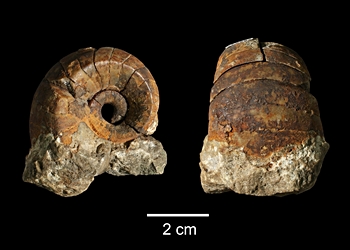 Vestinautilus sp. (Trigonoceratidae) : Kansas, USA Photo: Pennsylvanian Atlas of Ancient Life (Link). |
Nautiloid Shell Shapes).
IIt was from the Trigonoceratidae (see image right) that the modern true Nautiloidea s. str. eventually later evolved during the Triassic, including the living Nautilidae.
In the Late Devonian period, the number of Nautilida species had been decreasing for some time. However, in the Carboniferous, another wave of diversification took place, so that today about 16 families with overt 75 genera are known from the fossil record. Nautilida from the Carboniferous developed numerous different shell shapes, but horn-shaped (crytoconical) shells almost are entirely absent, with the exception of the Aipoceratoidea.
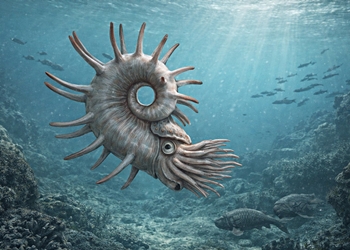 Cooperoceras texanum from the lower Permian (ca. 304 - 286 Mio. Jahre). AI Illustration: Martina Eleveld.
Enlarge! |
In the Triassic finally, from the Trigonoceratoidea the Syringonautilidae and consequently the Nautiloidea (s. str.) evolved, a part of which are the extant Nautilidae living today (Kummel, 1964).
| |
|
Kummel, B. (1964): "Nautilida" in Treatise on Invertebrate Paleontology, Part K. Mollusca 3. (Geological Society of America, and University of Kansas Press). (PDF, Ch. 2, S. 105 ff.). |
| |
|
Mikesh, D.L.; Glenister, B.F. (1966) "Solenochilus Springeri (White & St. John, 1868) from the Pennsylvanian of Southern Iowa", Proceedings of the Iowa Academy of Science, 73 (1), 269 - 278. (Link). |
| |
|
Teichert, C. (1988). "Main Features of Cephalopod Evolution". In Clarke, M.R.; Trueman, E.R. (eds.). Paleontology and Neontology of Cephalopods. The Mollusca. Vol. 12. Academic Press. |
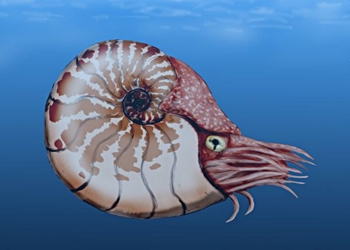 Among the genus Cenoceras, here Cenoceras lineatum from the middle Jurassic, were also the only surviving Nautilida. Photo: Nobu Tamura (Quelle). |
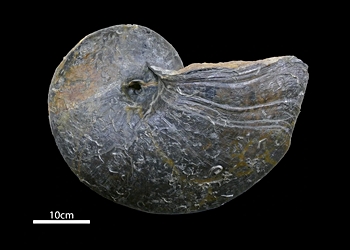 Cenoceras rumelangense (n. sp.), from the Ostrea limestone from the middle Jurassic, Gruibingen, Swabian Alb, Bade Wurttemberg. Source: Weis et al. (2022). |
Geological Time Periods, Europe).
However, in the end, the last surviving Nautilida turned out to be sufficient to undergo a new radiation in the beginning of the early Jurassic period and consequently the Nautilida were able to diversify and spread out again until the end of the Cretaceous period. So from the Cretaceous, about 24 genera of Nautilida are again known to us.
The research of shell-bearing cephalopods from the Jurassic has a long scientific tradition since the beginning of the 19th century (e.g. Sowerby, 1815 and d'Orbigny, 1843); however, the identification of many taxa remains challenging. The genus Cenoceras most likely must be seen as a collective group (or "catch-all group") of species, that in fact belong to several different groups, which so far still cannot clearly be separated.
The Swabian Alb is a mountain range in the southwest German state of Baden-Würtemberg. During the Jurassic, it was part of the Tethys Ocean, and home to a rich fauna of evertebrate sea creatures. So, in the sandy limestone deposits from the Middle Jurassic ("Brauner Jura" or "Dogger"), palaeontologists have found a lot of ammonite, belemnite, bivalve, brachiopod and gastropod fossils.
|
The K-Pg or K-T Extinction Event? The global extinction event at the end of the Cretaceous period, the asteroid impact leading to the extinction of the dinosaurs (see above), usually either is referred to as K-Pp or K-T extinction event. K-K-Pg is an abbreviation for Cretaceous-Paleogene, and instead, K-T stands for Cretaceous-Tertiary. Since the abbreviation C was already taken by the Carboniferous, even in English, K is used from the German "Kreide". |
| |
|
Weis, R.; Schweigert, G.; Wittische, J.; (2023): "A new giant nautilid species from the Middle Jurassic of Luxembourg and Southwest Germany". Swiss Journal of Palaeontology 142, 24. (Link). |
The final global extinction event at the end of the Creatceous period, 65 million years ago (also known as K-Pg or K-T extinction event) resulted in the complete extinction of the ammonites; the nautilids, however, were again able to survive. As to the reason for that, there are several theories: One possible theory is that the nautilids were better able to survive due to their larger eggs, but more likely they were better adapted to life in deeper water layers, so in turn the deadly conditions at the water surface had less severe impact on those species than on the ammonites.
Geo Girl:
Why
Ammonoids Went Extinct at the End Cretaceous While Nautiloids Survived?
Wikipedia:
Nautilida.
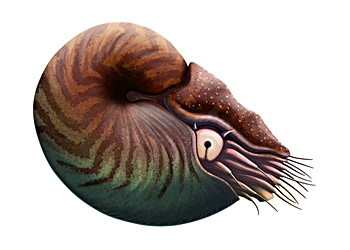 Aturia sp., a fossil Nautilid from the Palaeocene - Miocene (ca. 6 - 60 mya). Picture: Nix Illustration (Link). |
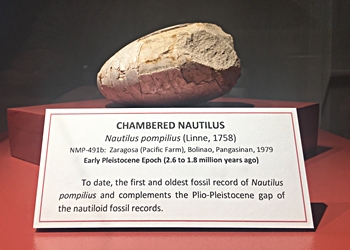 The oldest preserved fossil of Nautilus pompilius from the early Pleisto- cene (ca. 2,6 - 1,8 mya) of the Philippines. Photo: Julan S. Nueva. |
Today's ecological threats to nautilids, apart from the predation by pilot whales, also encompass oxygen minimum zones (OMZs) in deeper layers of the ocean, so nautilids cannot retreat in those zones. This is sadly added to by overfishing by humans, especially in the Philippines and Indonesia, together with the growing destruction of their natural habitats, especially coral reefs. Since many nautilids preferrably live in colder water layers, the increasing of the surface water temperature due to human and climatic factors, are also important causes.
Nautiluses (Nautilidae):
Economic Importance and Threat
Situation. Kiel,
S.; Goedert, J.L.; Tsai,
C.‐H. (2022): "Seals, whales and the Cenozoic decline of nautiloid cephalopods".
Journal of Biogeography. 49 (11): 1903 - 1910. (Link).
The fossil history of Nautiloids covers more than half a billion of earth's history. They survived ice ages, global extinctions and the ascent of new animal groups. Of the many former lines only a few species of Nautilus and Allonautilus sill remain today. That is why they especially offer us a unique insight into the early evolution of cephalopods and remind us, how closely todays animal world is liked to its fossil past.
YouTube Video).Latest Change:
11.07.2026 (Robert
Nordsieck).
Latest Link Check: 07.06.2026.
