| Diese Seite auf Deutsch! |
|
Giant Squid SpeciesGiant Squid, Colossal Squid and Humboldt Squid |
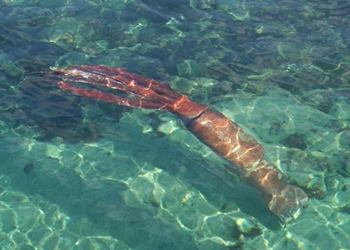 Giant Squid (Architeuthis dux), washed up near La Coruña, Spain, 2016. Photo: Javier Ondicol (Parque de la Vida). |
| Part 1 | Part 2 |
 Part 3 Part 3
 |
Part 4 |
|---|---|---|---|
Among the cephalopods, the largest of all recent invertebrates living today are to be found. Giant squids may have been known indirectly for centuries, because the stomach contents of hunted sperm whales (Physeter macrocephalus) often contained large numbers of their beaks (see Nutrition), and because the scars left by the hooks and sucker rings on the whales' skin provided further evidence of their existence (see Arms and Tentacles). However, Giant Squids remained little more than legends among whalers, almost mythical creatures, until the middle of the nineteenth century.
Cephalopods in Myths and Legends.
Unlike sperm whales, which must regularly return to the surface to breathe, Giant Squids rarely voluntarily leave the deep-sea environment in which they live. However, with the advent of modern deep-sea fishery techniques during the Industrial Revolution, Giant Squids began to be encountered more frequently. Since then, specimens have occasionally been captured in trawl nets or been harpooned, providing the first opportunities for scientists to examine these elusive animals directly.
Extinct Zoo:
When
Krakens Were Real. ( YouTube Video).
|
The "King Lizard" Among Squids? The scientific name of the Giant Squid has been assembled from several Greek and Latin parts: ἀρχός (archós): Ruler, τευθίς (teuthís): Squid, dux: Leader. Thus, Steenstrup in 1857 wanted to describe that this was the largest and most impressing squid on Earth. Today we know the Giant Squid is not the largest of all recent cephalopods; a title that is actually owed to the Colossal Squid. But Steenstrup could not have known that. But likewise, the Basilosaurus ("King Lizard" in Greek) is neither a king, nor a lizard. |
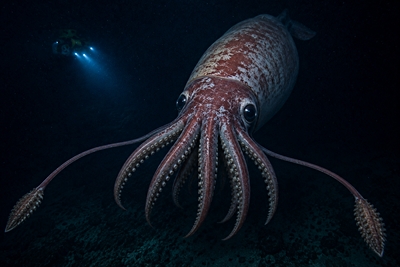
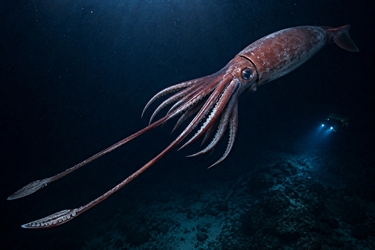 Giant Squid (Architeuthis dux): AI Illustration: Robert Nordsieck.
Enlarge Image! |
More than a century later, in 2004, the first images of living Giant Squids were finally obtained (Kubodera et al., 2005). Until that time, captured specimens had generally died either from injuries sustained during capture or from the effects of being brought to the surface from their deep-sea habitat. Initially, numerous species of Architeuthis were described. However, a DNA study published in 2013 demonstrated that all of these are best regarded as synonyms of a single species, Architeuthis dux.
 |
| MolluscaBase: Architeuthis dux Steenstrup, 1857. |
| |
| Kubodera, T.; Mori, K. (2005): First-ever observations of a live giant squid in the wild. In: Proc. Biol. Sci. 272, S. 2583–2586. (Abstract). |
| |
| Winkelmann, I. et al. (2013): Mitochondrial genome diversity and population structure of the giant squid Architeuthis: genetics sheds new light on one of the most enigmatic marine species. Proceedings of the Royal Society 280 (1759). (Abstract). |
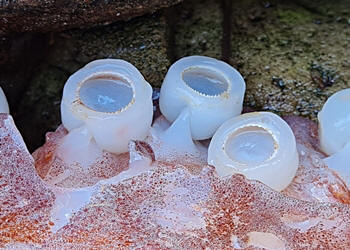 Suckers of a Giant Squid with toothed rims. Photo: Marian Oliver (iNaturalist). |
Today it is generally accepted that Giant Squids can grow to mantle lengths exceeding 2 metres, while the two feeding tentacles may add more than 10 metres to the total length. Most specimens encountered, however, are considerably smaller. Earlier estimates of Giant Squid size were often based on the diameter of sucker scars found on sperm whales (Physeter macrocephalus). Today, it is known that these scars enlarge as the whale's skin grows, making them only a very rough indicator of the size of the squid that produced them. The suckers of Giant Squids themselves can reach diameters of slightly over 5 cm. In addition, the sucker rings are armed with small teeth that provide a firmer grip on prey.
Giant Squids occur in all oceans but appear to favour temperate waters. Most records and sightings originate from Newfoundland, Spain, Portugal, South Africa, Namibia, Japan, New Zealand and Australia. Although the open ocean appears to be their preferred habitat, nearby marginal seas such as the Tasman Sea, the Caribbean Sea and the Gulf of Mexico also seem to provide suitable environments. While there have been occasional reports from the Mediterranean Sea, Giant Squids do not appear to be native there. They are thought to inhabit depths ranging from approximately 300 - 500 metres down to around 1,000 metres, depending upon the source consulted. Their soft bodies are highly adapted to deep-sea conditions, which explains why most captured individuals die when brought to the surface.
Perhaps the most striking feature of the Giant Squid are its enormous eyes, which may reach diameters of up to 25 cm and thus rank among the largest eyes in the animal kingdom, surpassed only by those of the Colossal Squid (see below). Such eyes provide a significant advantage in the darkness of the deep sea, enhancing both prey detection and predator avoidance.
Colour plays only a limited role in the deep sea because, with increasing depth, almost exclusively short-wavelength blue light remains. Red-coloured animals therefore appear almost black and are surprisingly well camouflaged. Many deep-sea cephalopods consequently display a reddish colouration. At the same time, the eyes of many deep-sea cephalopods are highly specialised for detecting faint sources of light, particularly bioluminescence, whereas colour vision itself probably plays only a minor role in the perpetual darkness of their environment.
Nilsson, D.; Warrant,
E.; Johnsen, S.; Hanlon,
R.; Shashar, N. (2012): A Unique Advantage for
Giant Eyes in Giant Squid. Current Biology 22, S. 683 - 688.
Auralis:
Why Deep
Sea Camouflage Gets Weirder The Deeper You Go. (
YouTube Video).
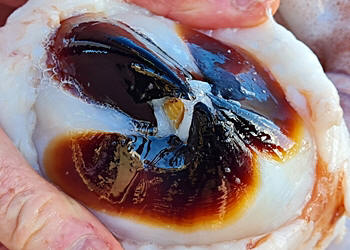 Beak of a Giant Squid. Photo: Marian Oliver (iNaturalist). |
see
Cephalopod Systematics!).
Rapid movement over short distances is achieved by jet propulsion, while slower locomotion is assisted primarily by the well-developed fins at the posterior end of the mantle.
Unlike the Chambered Nautilus, squids have lost the buoyancy-regulating shell, retaining only a highly reduced internal remnant known as the gladius. To compensate, Giant Squids utilise a concentrated solution of ammonium chloride within their tissues. This solution is less dense than seawater and therefore provides buoyancy. Ammonium chloride, also known as sal ammoniac, is also one of the reasons why Giant Squids are generally considered unsuitable for human consumption.
Two Oceans Aquarium,
Südafrika (2022):
Everything you need to know about giant squids.
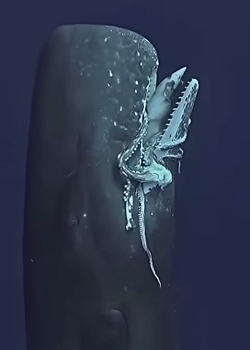 Sperm Whale (Physeter macrocephalus) surfacing with a Giant Squid. Source: YouTube Shorts. |
While juvenile Giant Squids may occasionally be captured by seabirds when they stray near the surface, the principal predators of Giant Squids are sharks and various species of whales. In their natural environment, however, the only animal likely to be a serious threat to a fully grown Giant Squid is an adult sperm whale.
This relationship has resulted in a remarkable evolutionary arms race. The Giant Squid can use its enormous, highly developed eyes, possibly aided by the detection of bioluminescent disturbances, to detect an approaching sperm whale at a considerable distance. The sperm whale, on the other hand, possesses echolocation with a greater range than the squid's vision, compensating for its limited sight in the deep sea. Ultimately, the outcome depends upon whether the squid can evade capture long enough for the whale to be forced to return to the surface to breathe.
However, the enormous numbers of squid beaks recovered from the stomachs of hunted sperm whales provide compelling evidence that, once detected, a Giant Squid's chances of survival are generally rather poor.
Washed-up Giant Squid in Scarborough (16.08.2022, North Cape Province, South
Africa) on iNaturalist.
Phil Eyden:
England's Architeuthis (Scarborough, North Yorkshire, England, 1930's). (The
Octopus News Magazine Online, 2020).
Mainecoon6122:
Epic
Moment: Sperm Whale Surfaces with Giant Squid!.(
YouTube Short).
ARD Alpha (German):
Den Riesenkalmar gibt es in der Tiefsee wirklich. (Mit
Bilderserie).
Sarah Keartes (Earth
Touch News Network, 2016):
Washed-up giant squid shows signs of fierce deep-sea fight.
Ellis,
R.: "The Search for the Giant Squid". Lyons Press, 1998. (Link).
OctoLab:
Meet The
Squid That Refuses to Be Seen by Humans. (
YouTube Video).
Science.orf.at (German):
Augen groß wie Basketbälle.
Wild Life
Documentary:
The
Greatest Hunt You've Never Seen: Sperm Whale vs. Giant Squid. (
YouTube Video).
Steve
O'Shea and
Kat
Bolstad:
Giant Squid and Colossal Squid Fact Sheet. (The
Octopus News Magazine Online, 2008/2019).
The giant squid had become relatively well known following its discovery in the mid-19th century, after centuries of myths and sailors’ tales. At regular intervals, specimens were washed ashore or caught in fishing nets in many parts of the world (see above). In the 1920s, however, it became apparent that there was another very large species of squid that humans encountered even more rarely. This would gradually change with the expansion of deep-sea fisheries in Antarctic waters.
In 1925, several fragments of squid tentacles were discovered in the stomach of a captured sperm whale. Robson described, among other features, the remarkable rotating hooks on the tentacular clubs and the hooks on the shorter arms. Because of these distinctive characteristics, G. C. Robson decided to describe this squid as a new species, Mesonychoteuthis hamiltoni, even though only fragmentary remains were available.
Robson,
G.C. (1925). "On Mesonychoteuthis, a new genus of oegopsid, Cephalopoda". Annals
and Magazine of Natural History. 9 (16): 272–277. (Summary).
MolluscaBase:
Mesonychoteuthis hamiltoni G. C. Robson,
1925.
Since then, only a handful of colossal squids have been recorded. In 1981, a Soviet trawler caught an immature female in the Ross Sea measuring about 4 m in total length. In 2003, another immature female with a total length of 6 m and a mantle length of 2.5 m was captured in Antarctic waters. Yet another immature female of similar dimensions was found near the surface in the Antarctic in the same year. The first live specimen was encountered in 2005, when fishermen using a longline near South Georgia caught an individual that had seized a bait fish. Its mantle length was estimated at 3.5 m, its tentacles at 2.3 m, and its weight at approximately 150–200 kg, although only parts of the feeding tentacles could be recovered.
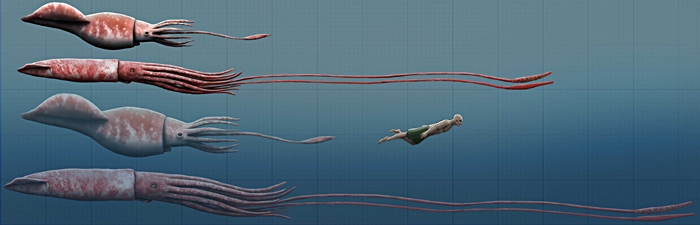 Colossal Squid (Mesonychoteuthis hamiltoni, top) and Giant Squid (Architeuthis dux, bottom) in comparison. Picture: Harry Wilson. Top: Proven specimens (see O'Shae und Bolstad: Giant Squid and Colossal Squid Fact Sheet). Bottom: Assumed sizes, calculated from beak sizes and incomplete specimens. |
BBC News Asia-Pacific (22.02.2007): "NZ
fishermen land colossal squid".
Alison Ballance (Radio New
Zealand, 16.09.2014):
Colossal squid to give up its secrets.
This specimen provided a wealth of new information:
|
Giants of the Deep Sea - How Do They Get So Big? That animals living in the deep sea often are built noticeably larger and heavier than their relatives from the upper sea levels, has different reasons:
This phenomenon, also called abyssal gigantism, can be observed in various animal groups, such as crustaceans, worms, cnidarians and also cephalopods. However, the reasons are not entirely understood, since different factors might interact simultaneously to produce this effect. Source:
Wikipedia:
Deep
Sea Gigantism. (Accessed: 13.05.2026). |
The eyes of the colossal squid are believed to be the largest known in the animal kingdom, with measured diameters of at least 27 cm and pupils 8–9 cm across. It has been suggested that the eyes of living individuals may reach 30–40 cm in diameter. The visual centres of the brain are exceptionally well developed. In addition, colossal squids possess light-producing organs (photophores), which form vertical bands behind the eyeballs. The light they produce probably serves to illuminate nearby surroundings and potential prey in the darkness of the Antarctic deep sea. This bioluminescence is generated by chemical reactions, possibly involving symbiotic bacteria.
The beak of the museum specimen measured 38 mm in lower rostral length. However,
substantially larger squid beaks have been recovered from the stomachs of sperm
whales, indicating that colossal squids are capable of growing to considerably
greater sizes than the specimen examined.
The feeding tentacles of the
colossal squid are armed with toothed suckers, as are those of the giant squid.
In addition, however, colossal squids possess chitinous hooks on both the arms
and the club-like ends of the long tentacles. The hooks on the arms are fixed in
place, each sitting within a muscular sheath and arranged in double rows along
the arms. These hooks are three-pointed, consisting of a main tip and two
smaller basal points. By contrast, the hooks on the tentacular clubs are smaller
and single-pointed. They are capable of rotating through 360°, although it
remains unclear whether the squid can actively control this movement. These
hooks are likewise arranged in double rows along the midline of the tentacular
clubs, while rows of small suckers run along the outer side of each hook row. In
total, each club bears approximately 20–25 hooks.
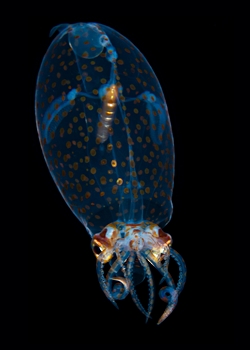 Glass Squid (Teutowenia pellucida): Poor Knights Is- lands, New Zealand. Photo: P. Caiger (iNaturalist). |
Although other squid groups also possess tentacular hooks, however the giant squid does not, apart from the toothed rings surrounding its suckers.
New Zealand National Museum
(Te Papa Tongarewa):
Colossal Squid (Arms
and Tentacles).
BeyondTheBlue:
Why
Squids Are So Terrifying In The Antarctic. (
YouTube Video).
The hook-bearing feeding tentacles also explain the origin of the scientific
name Mesonychoteuthis. The name derives from the Greek μέσος (mésos,
"middle"), ὄνυξ (ónyx, "claw" or "hook"), and τευθίς (teuthís, "squid"). In
effect, the name may be translated as "Hamilton’s middle-hook squid".
Systematically, however, it belongs to a different lineage from the giant
squids, being a member of the family Cranchiidae (the glass squids) within the
order Oegopsida (
see
Cephalopod Systematics!).
In 2025, a 30 cm juvenile colossal squid was documented alive in its natural habitat near the South Sandwich Islands during an oceanographic expedition in the South Atlantic. These juveniles, or paralarvae, are transparent and closely resemble those of the Antarctic glass squid (Galiteuthis glacialis), which inhabits the same waters. Because researchers encountered both species during the expedition, it appears that identification was possible based on the distinctive arm hooks of the juvenile colossal squid.
Nat Geo Animals:
Hunt for
the Giant Squid (2019). (
YouTube Video).
Schmidt Ocean
Institute:
Colossal
Squid, 1st Live Observation (2025). (
YouTube Video).
Wikipedia:
Colossal
Squid.
 Alexander von Humboldt (1769 - 1859). Painting by Joseph Karl Stieler (Source). |
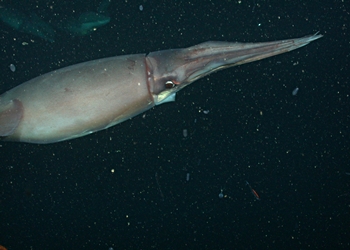 Humboldt Squid (Dosidicus gigas) in ca. 480 m depth: Sur Canyon, Cali- fornia, USA. Photo: Kevin L. Stierhoff (NOAA). |
|
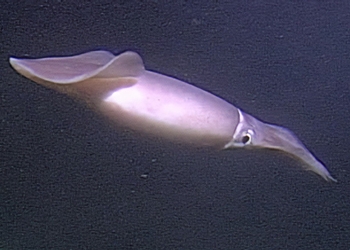 Humboldt Squid in 395 m depth: Barkley Canyon, British Columbia, Ca- nada. Photo: Ocean Networks Canada (iNaturalist). |
see
Cephalopod Systematics!). Unlike these giant deep-sea squids, the Humboldt
Squid is of considerable commercial importance and has also attracted attention
because of reports that it has occasionally attacked humans.
MolluscaBase:
Dosidicus gigas (A. d'Orbigny, 1835).
The Humboldt Squid takes its name from its principal area of distribution. It is found primarily along the Pacific coast of South and Central America, where the Humboldt Current (named after the explorer Alexander von Humboldt), also known as the Peru Current, flows northwards along the coasts of Chile and Peru before turning westwards south of the Equator. Originating in Antarctic waters, this cold, relatively low-salinity current, together with nutrient-rich upwelling from deeper waters, creates one of the most productive marine ecosystems on Earth.
At depths of approximately 200–700 m, Humboldt Squids prey upon fish and other cephalopods. Their range extends from Patagonia in the south to California in the north. Occasional specimens have even been recorded farther north, including in Puget Sound (Washington State, USA) and British Columbia (Canada). However, this distribution is increasingly affected by environmental change. Events such as El Niño warm the water, reducing its oxygen content and ultimately its productivity. The resulting decline in fish and other cephalopods leads to a reduction in Humboldt Squid populations. Similar effects may be expected from long-term climate change. At the same time, warming oceans may encourage northward range expansions, since Humboldt Squids are highly tolerant of low-oxygen conditions and tend to follow the distribution of their prey.
Zeidberg,
L.D.; Robison, B.H. (2007): "Invasive
range expansion by the Humboldt squid, Dosidicus gigas, in the eastern
North Pacific". Proc. Natl. Acad. Sci. U.S.A. 104 (31) 12948 - 12950. (Link).
Humboldt Squids are the largest members of the Ommastrephidae, a family often referred to in English as the "Flying Squids". They usually occur in schools that may contain up to 1,200 individuals. Using the typical cephalopod jet-propulsion system, they can attain swimming speeds of up to 24 km/h (13 knots). Their large mantle fins are primarily used for slower and more energy-efficient locomotion.
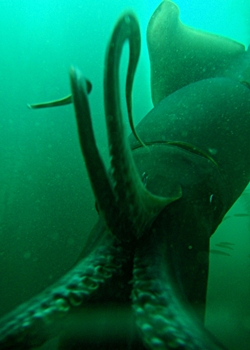
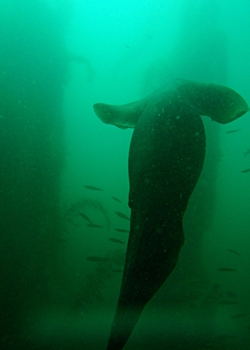 An encounter with a Humboldt Squid: La Jolla, California, USA. Photos: Ferleys (iNaturalist). |
The prey of the Humboldt Squid consists mainly of smaller fish, crustaceans and other cephalopods. Like the colossal squid, it possesses both toothed suckers and chitinous hooks on the clubs of its long feeding tentacles. During a hunting attack, the squid approaches its prey while forming a funnel-like structure with its eight shorter arms. When the prey comes within range, the long feeding tentacles are shot forward at high speed. The hooked tentacular clubs seize the prey and draw it towards the shorter arms, which then pass it to the mouth. There, the sharp beak, assisted by the radula, tears the prey apart before it is swallowed.
Whether Humboldt Squids truly engage in coordinated group hunting remains controversial. Several studies have proposed such behaviour, although its interpretation has been questioned by other researchers.
Helena Smith (Deep
Sea News):
Coordinated Hunting in Red Devils.
BBC Earth:
2 Metre
Long Humboldt Squid Hunt In Packs. (
YouTube Video).
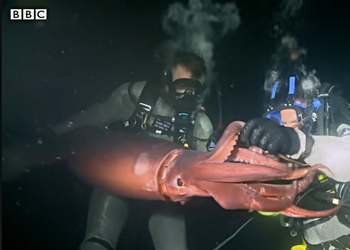 Divers encounter a Humboldt Squid (Dosidicus gigas). Source: The Travel Edit: Red Devil Squid Bites Diver. |
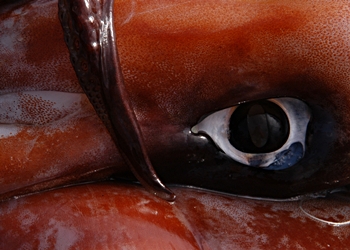 The eye of a Humboldt Squid (Dosidicus gigas). Photo: JoeScience1 (iNaturalist).
Enlarge Image! |
The somewhat sinister nickname is also linked to the fact that Humboldt Squids, like many cephalopods, often display an intense red colouration when excited or aggressive. Furthermore, they are capable of showing aggressive behaviour towards humans. Such incidents usually occur during feeding activity, either through mistaken identity or because the squids are attracted or irritated by brightly coloured diving equipment and artificial lights. In such situations, the powerful beak is fully capable of penetrating human skin. Divers operating in areas where Humboldt squids are common therefore sometimes wear chainmail suits or similar forms of protective equipment.
Our World
(2004):
The Truth About Killer Squid. (
YouTube Video).
The
Travel Edit:
Red Devil
Squid Bites Diver. (
YouTube Video).
The Humboldt Squid is among the most heavily exploited cephalopod species. It is primarily caught using baited longlines. The annual human consumption of approximately one million tonnes of squid is particularly noteworthy because, like the aforementioned Giant Squid and the Colossal Squid, they likewise contain ammonia compounds to support buoyancy, even if the Humboldt Squid is considerably more active and agile than either of those species.
As a result, the meat must be processed before it is suitable for human consumption. One method involves tenderising freshly caught squid, soaking it for three hours in ice water containing a 1% solution of lactic and citric acids, washing it, and then immersing it for a further three hours in a 6% brine solution. Only after this treatment can the squid be marketed, for example as squid steaks.
Latest Change:
11.07.2026 (Robert
Nordsieck).
Latest Link Check: 24.05.2026.