| Diese Seite auf Deutsch! |
|
Amazing Facts About CephalopodsCephalopoda Cuvier, 1797 |
 |
|
 |
|
 |
|
 |
 A Broadclub Cuttlefish (Ascarosepion latimanus) camouflaged against the sandy ocean floor. Photo: Nick Hobgood (Source). |
Another common name used for many cephalopods is "inkfish" (for example in German and Dutch). Of course, cephalopods are not fish, and some of them do not even possess an ink sac. Those that do, however, are able to release a dark cloud of ink when threatened and retreat under its cover.
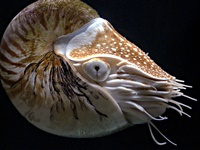
Most living cephalopods lack an external shell, with the exception of the Chambered Nautilus (Nautilus pompilius), which, because of this and many other primitive characteristics, is often regarded as a living fossil. However, the fossil record contains a great diversity of shell-bearing cephalopods from many periods of Earth's history, including groups such as ammonites and belemnites.
Although some fossil cephalopods reached enormous sizes, most living species are relatively small, with a few remarkable exceptions. Among the ten-armed squids, the giant squid and the colossal squid can grow to of several metres in length and weights of several hundred kilograms. Yet although giant octopuses and sea monsters are frequently mentioned in myths and legends throughout human history, the largest living octopuses are comparatively modest in size.
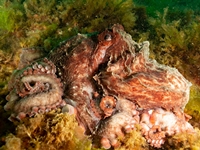
With almost 1,000 known living species, cephalopods account for only around 1% of all living molluscs. Unlike snails (Gastropoda) and bivalves (Bivalvia), they never left the marine environment during their evolutionary history. Octopuses in particular are nevertheless capable of short excursions out of water and may move between tidal pools.
Particularly remarkable is the highly developed nervous system of cephalopods. In addition to a central brain, octopuses, for example, possess further peripheral nerve centres within their eight arms, allowing them to function to a large extent independently. The eyes of most cephalopods are also highly developed. Apart from the pinhole camera eyes of nautiluses, most living cephalopods are equipped with very sophisticated lens eyes, and those of the giant and colossal squids rank among the largest eyes in the animal kingdom. Many cephalopods are also capable of actively changing their colour by means of specialised pigment cells in the skin, known as chromatophores. They use this ability for camouflage, communication and even to confuse prey.
Cephalopods have been of great importance to humans since the earliest times. Many species, particularly squids and octopuses, are harvested as food. Cephalopods are also studied in order to better understand their remarkable abilities. Octopuses in particular are regarded as the most intelligent invertebrates and have demonstrated the ability to solve problems. As a result, they are popular inhabitants of many aquaria and zoological collections.
However, human fascination with cephalopods is not purely economic or scientific. Since the earliest recorded history, countless legends involving cephalopods have existed. Although many of these stories can now be explained through scientific research and technological advances, there remains a great deal that is still unknown about these animals.
It is the aim of this website to introduce you to this fascinating group of animals and to awaken an interest in a world that, even today, often literally and figuratively, remains hidden beneath the surface.
 Auralis and
Natural World Facts:
Why
Octopuses Haven't Taken Over The World... Yet. (
Auralis and
Natural World Facts:
Why
Octopuses Haven't Taken Over The World... Yet. ( YouTube Video).
 "The Living World of Molluscs" on https://www.molluscs.at by Robert Nordsieck for 25 years: 2000 - 2025! |
|
|
 German Malacozoological Society all about mollusc research. |
 Tonmo.com: The Octopus News Magazine Online mit eigenem YouTube-Kanal. |
 Molluskenforschung Austria Austria-wide platform for mollusc researchers. |
 Weichtiere beim Naturschutzbund Deutschland (NABU) |
Latest Change:
11.07.2026 (Robert
Nordsieck).
Latest Link Check: 24.05.2026.