
| Diese Seite auf Deutsch! |
|
The Roman SnailHelix pomatia Linnaeus, 1758 |
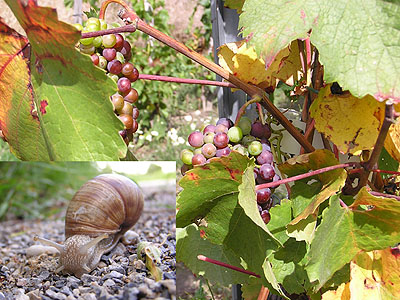 Roman snails (Helix pomatia) are not exclusively found in vineyards. Photo: Cornelia Kothmayer. |
The Roman snail is also one of the few Central European snail species cultivated economically, surpassed only by its relative, the brown garden snail (Cornu aspersum), which in France, one of the centres of European heliciculture, is also called Escargot Petit Gris. Cultivation and economic use of the Roman snail, especially in Southern Germany and Austria, have a very old tradition dating back at least into the Middle Ages.
 Snail Cultivation.
The History of Snail Cultivation.
Historically there is the assumption that the Roman snail could only spread through Central Europe, when because of human settlement migration, at least by the time of Germanic migration and land grab, the Hercynian primordial forest covering at the time most of Central Europe was cut back for fields. Only then the forest rim and bush vegetations appeared, that even today are the favourite habitats of the species.
The Roman snail: Habitat.
While in English, Helix pomatia is called "Roman Snail", since it most likely was introduced to the British Isles by the Romans; and in French it is called "Escargot des Bourgogne" (Burgundy snail), the German term "Weinbergschnecke" (vineyard snail), as well as the Russian "Виноградная улитка" refers to the species often found in vineyards. Those, on the other hand, are often placed on fertile calcareous or loess soil. The reasons, why the Roman snail, as well as many other snail species, often are found on those types of soil, are multiple: The calcium carbonate contained in limestone is used by the snails to build their shells. Also, the usually lush vegetation, as long as there is sufficient precipitation, is used by the snails as protection and food source.
The Roman Snail: Shell.
The Roman Snail: Nutrition.
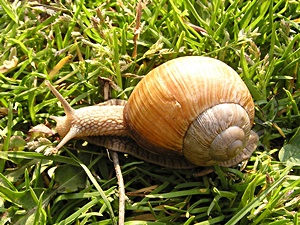 A Roman snail king (Helix pomatia). Photo: Robert Nordsieck.
Enlarge! |
The Roman snail: Snail King.
Roman snails' behaviour is equally well researched. The mating play of the Roman snail may not be as spectacular as that of the leopard slug (Limax maximus), but nonetheless worth a watch. What is also interesting to know is that during mating, Roman snails use a so-called love dart. The knowledge, what this love dart is used for, is not yet that old.
The Roman Snail: Reproduction.
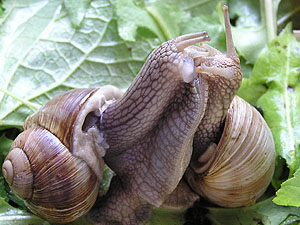 In spring, when the Roman snails have woken from hiberna- tion, mating time begins. |
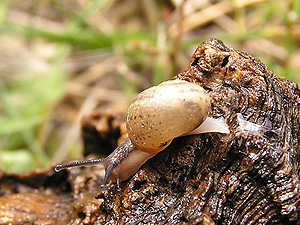
Juvenile Roman snail, a few weeks old. Photos: Robert Nordsieck. |
The Roman snail:
Hibernation and
aestivation.
Systematically, the Roman snail is part of the Helicidae snail family, together, for example, with the banded snails, the copse snail (Arianta arbustorum), together with a multitude of mainly Mediterranean species, such as the sandhill snail (Theba pisana) and the chocolate banded snail (Eobania vermiculata).
Helicid snails (Helicidae).
The Roman snail:
Relatives.
Finally, the Roman snail is to be described here in more detail as an example for the terrestrial snails. The biology of the Roman snail indeed is a fascinating chapter of European natural history. Because, in the end, who would have thought that Roman snails have thousands of teeth, but only one foot, which they can use to crawl hanging upside down and even to master the sharpest of blades?
That they have been collected as food for humans for millennia, makes the Roman snail on of our best-known snail species. However, we should not assume to know everything about those interesting creatures, since even today there are new thing to find out about them.

"The Living World of Molluscs" on
http://www.molluscs.at
by Robert Nordsieck for 25 years: 2000 - 2025!
 The YouTube Channel of Weichtiere.at with several videos ready to watch!
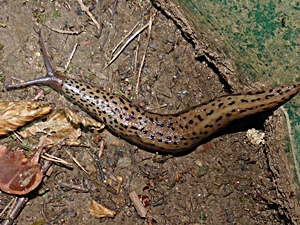
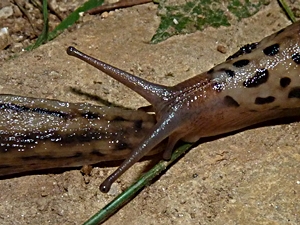
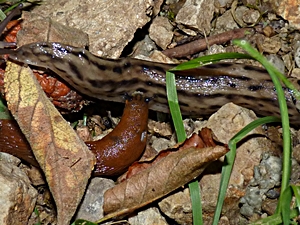
New: The page about
leopard slugs (Limax maximus) has been
completely revised, now showing many new photos by
Martina Eleveld,
especially about
their mating procedure, together with a
Video Playlist on the same topic on our
YouTube Channel!
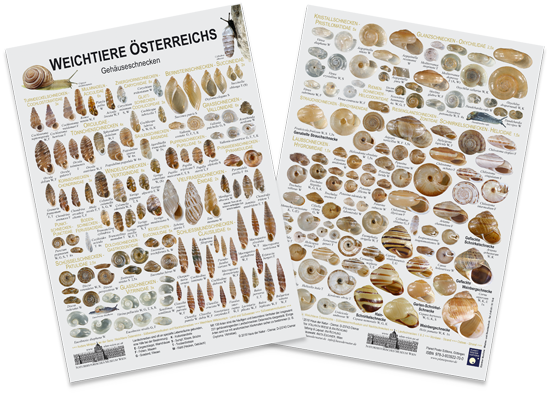
Picture:
Haus der Natur in Cismar.
Identification charts "Molluscs of Austria - Snails with a Shell" and
"Molluscs of Austria - Fresh Water Snails and Slugs"
Additional
Information!
(In German).
Available in the
Vienna Natural History
Museum and in the Haus
der Natur in Cismar, Germany.
Overview over German and Dutch identification charts:
http://www.miniposter.hausdernatur.de/.

http://www.mollusca.de: Homepage of the
German Malacozoological Society all about mollusc research.

Molluskenforschung Austria
Austria-wide Platform
for Mollusc Researchers.
Naturkundemuseum Stuttgart:
Molluscs - Identification, Systematics, Finding Reports.

Molluscs at Naturschutzbund Deutschland (NABU)
(German Nature Conservation Society)
Latest Change: 03.10.2025 (Robert Nordsieck).