Glass SnailsVitrinidae Fitzinger, 1833 |
| Diese Seite auf Deutsch! |

|
|
|
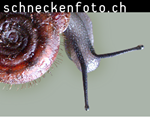
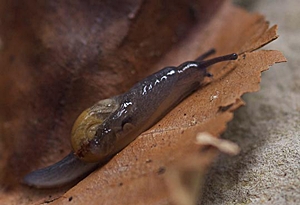 Ear Shaped Glass Snail (Eucobresia diaphana). Photo: © Stefan Haller (schneckenfoto.ch). |
|
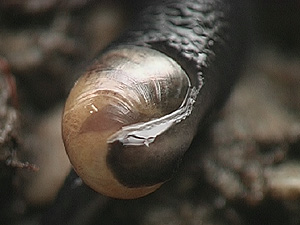 Mantle flap of Eucobresia diaphana. Photo: Andreas Heidl. |
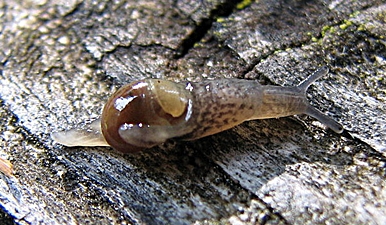 Mountain Glass Snail (Hessemilimax kotulae). Photo: Gianbattista Nardi. |
The extremely thin shell of glass snails already reveals their close similarity to slugs. For example, when comparing the Translucent Glass Snail (Vitrina pellucida) with the Ear-Shaped Glass Snail Eucobresia diaphana, it becomes obvious that while the Crystal Snail still owns a shell into which it can completely withdraw, Eucobresia diaphana has a comparatively smaller shell with fewer whorls, the final whorl being expanded into an ear-like shape, which also explains its common name. As a consequence, it can no longer fully retract into its shell.
Differences can also be seen in the shape of the mantle. From the Translucent Glass Snail to other species of glass snails, one can observe that the mantle shield increasingly extends over the shell from the front. In addition, a mantle lobe of varying size extends over the spire on the right side. In some species of glass snails, the shell may become almost completely covered by the mantle.
For example, Oligolimax annularis carries a relatively large shell into which it can still fully withdraw. Its genus name Oligolimax literally means "less slug-like", because among glass snails it shows the fewest slug-like characteristics. On the other end, the Half-Slug Glass Snail (Semilimax semilimax) has a shell that is already so extensively overgrown by the mantle that, as its name Semilimax ("half slug") suggests, it has become almost slug-like (see illustrations at the bottom of the page).
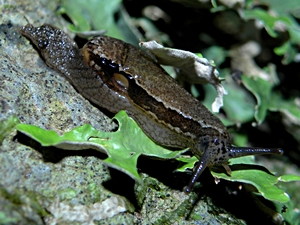 Madeirovitrina ruivensis: Madeira, Portugal. Photo: Sébastien Sant (iNaturalist). |
Similar situations can be observed in other groups of snails, for example in the tropical family Helicarionidae. Slugs have evolved repeatedly and independently during the evolutionary history of land snails. This evolutionary pathway of shell reduction is known as vitrinisation, named after the family Vitrinidae, the glass snails, which represent only one of several possible evolutionary routes towards this strategy.
  |
| Groh, K.; Rähle, W.; Kittel, K.; Hemmen, J.; Bank, R. (2009): Corrections and Additions to Mary B. Seddon's "The Landsnails of Madeira". Conchylia 40, (3/4), 2 - 25. (In the paper, Madeirovitrina is still referred to as Plutonia). |
| |
| MolluscaBase eds. (2025): Madeirovitrina Groh & Hemmen, 1986. |
Similar conditions can be observed in other snail groups, such as the tropical family Helicarionidae. Slugs have evolved independently during the evolution of terrestrial snails. The evolutionary path of shell reduction is also referred to as vitrinisation, after the family of glass snails (Vitrinidae), which have gone but only one of the paths possible in this strategy. On the other hand, in the English language, as well as usually in scientific language, another term is used: Limacisation, a term coined by Alan Solem in 1974, describing the evolution of snails bearing shells to slugs, derived from the Latin word Limax for a slug in general and especially the Limax genus in the Limacidae family of slugs.
More about
Slugs.
Image Display: Glass Snail Relatives (Vitrinoidea:
Systematics outdated).
Vitrinisation or Limacisation: The reduction of the snail
shell in terrestrial gastropods.
Solem,
G.A. (1974): "The Shell Makers". Wiley, New York, 1974 (Link).
Animal Fact Files:
Glass Snail - The Winter Snail ( YouTube Video).
Order: Stylommatophora
 Superfamily: Limacoidea
 Family: Vitrinidae Fitzinger 1833
Source: MolluscaBase eds. (2021): Vitrinidae Fitzinger, 1833.
Systematically the glass snail family (Vitrinidae) is placed in the superfamily of Limacoidea, which means they are most closely related to keel-back slugs (Limacidae).
Translucent Glass Snail - Vitrina pellucida (O. F. Müller, 1774)
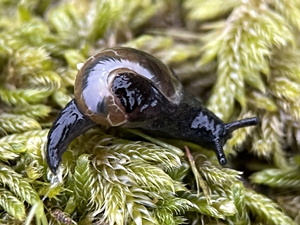 Translucent Glass Snail (Vitrina pellucida): Helperknapp, Luxemburg. Photo: Christiane Wolff (iNaturalist). |
Size: L: 4 - 6 mm; W: 2,5 - 3,5 mm; Length of animal: 10 mm.

Habitat and Distribution: The Translucent Glass Snail generally inhabits moderately open meadow locations, humid or dry habitats in deciduous and coniferous forests, in grassland or in fallow land. Of all glass snails, this species lives in the driest habitats, but is very adaptable to larger ecological differences.Vitrina pellucida can also be found on rocks and walls, in the pebble layer of streams, in the waterside vegetation and even on alpine meadows. Sometimes it is present in places with little vegetation cover, and it even tolerates soil of a more acidic composition.
The distribution area of this species spreads from Europe as far as Central Asia, in the North even beyond the Arctic Circle. In Switzerland, Vitrina pellucida occurs in elevations up to 2700 m above MSL.
Francisco Welter-Schultes:
Vitrina pellucida species homepage.
MolluscaBase eds.
(2025):
Vitrina pellucida (O. F. Müller, 1774).
Naturportal Südwest
(German):
Vitrina pellucida.
Ear Shaped Glass Snail - Eucobresia diaphana (Draparnaud, 1805)
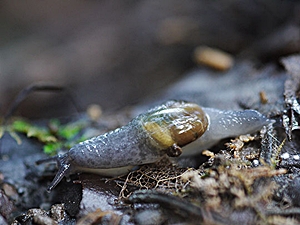 Ear Shaped Glass Snail (Eucobresia diaphana). Photo: © Stefan Haller (schneckenfoto.ch). |
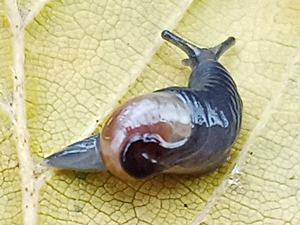 Ear Shaped Glass Snail (Eucobresia diaphana): Štěchovice, Czechia. Photo: Michal Honskus (iNaturalist). |
Habitat and Distribution: The Ear-Shaped Glass Snail lives in humid and cool places on the valley floor and in the mountains. In the low country, Eucobresia diaphana is found in shadowy and humid habitats in forests, in higher elevations also in open places, between short bushes and in grassland with a sufficient number of hiding places.
Eucobresia diaphana is found in Europe, from the Pyrenees as far east as the Balkans and as far north as Northern Germany, the southeastern Netherlands and especially in the Alps. In Switzerland, it is found as far up as 2900 m above MSL.
Threat Situation: In Rhineland-Palatia, Eucobresia diaphana is rated as endangered (see: IUCN Threat Categories).
Francisco Welter-Schultes:
Eucobresia diaphana species homepage.
MolluscaBase eds.
(2025):
Eucobresia diaphana (Draparnaud, 1805).
Naturportal Südwest
(German):
Eucobresia diaphana.
Mountain Glass Snail - Hessemilimax kotulae (Westerlund, 1883)
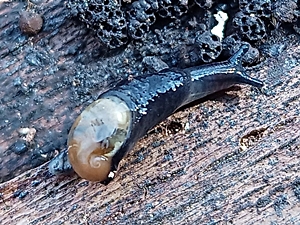 Mountain Glass Snail (Hessemilimax kotulae): Krhanice, Cze- chia. Photo: Michal Honskus (iNaturalist). |
Size: L: 4 - 6 mm; W: 3 - 4,5 mm; Length of animal: 12 - 15 mm.
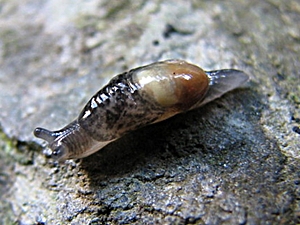 Mountain Glass Snail (Hessemilimax kotulae). Photo: Gianbattista Nardi. |
Hessemilimax kotulae is widely spread in the Alps and in the Carpathians, in Switzerland the species is found only between 1300 und 2600 m above MSL.
Threat Situation: The Mountain Glass Snail is rare and dispersed. In Bavaria it is rated as critically endangered and in Austria as endangered (see: IUCN Threat Categories).
Francisco Welter-Schultes:
Semilimax kotulae species homepage.
MolluscaBase eds.
(2025):
Hessemilimax kotulae (Westerlund,
1883).
Naturportal Südwest
(German):
Hessemilimax kotulae.
Nardi,
G.; Niero, I.; Braccia,
A. (2007): Nota sui Vitrinidae (Gastropoda, Pulmonata) viventi in provincia di
Brescia. Natura Bresciana 35 (2007), 101 - 119.
Complete Species List for Austria
Source: MolluscaBase eds. (2021): Vitrinidae Fitzinger, 1833.
Vitrinidae Fitzinger, 1833
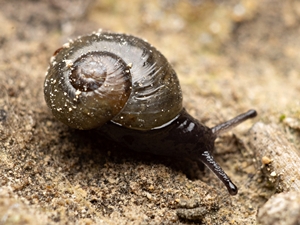 Oligolimax annullaris: Kütahya kalesi, Turkey. Photo: Mehmet Akif Suna (iNaturalist) |
|
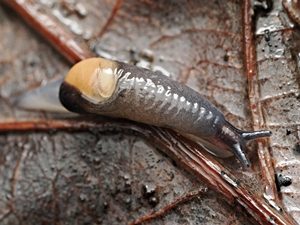 Wide-mouthed Glass Snail (Semilimax semilimax): Moszczan- ka, Poland. Photo: Michał Górski (iNaturalist). |
|
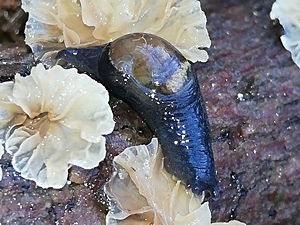 Short Glass Snail (Vitrinobrachium breve): Ballenstedt, Harz, Germany. Photo: Amigolimax (iNaturalist). |
Vitrininae Fitzinger, 1833
Eucobresia H.B. Baker, 1929
Eucobresia diaphana (Draparnaud, 1805)
Eucobresia nivalis (Dumont & Mortillet, 1854)
Eucobresia pegorarii (Pollonera, 1884)
Eucobresia glacialis (Forbes, 1837)Hessemilimax Schileyko, 1986
Hessemilimax kotulae (Westerlund, 1883)
Oligolimax P. Fischer, 1878
Oligolimax annularis (S. Studer, 1820)
Semilimax Stabile, 1859
Semilimax semilimax (J. Férussac, 1802)
Semilimax carinthiacus (Westerlund, 1886)Semilimacella Soós, 1917
Semilimacella carniolica (O. Boettger, 1884)
Vitrinobrachium Künkel, 1929
Vitrinobrachium breve (A. Férussac, 1821)
Vitrina Draparnaud, 1801
Vitrina pellucida (O. F. Müller, 1774)
 YouTube Video).
 With Photos by Stefan Haller: http://www.schneckenfoto.ch. |
Latest Change:
27.07.2026 (Robert
Nordsieck).
Latest Link Check: 27.05.2026.
