SlugsLife (Almost) Without a Shell |
| Diese Seite auf Deutsch! |

|
|
|
The Term "Slugs" is generally used for gastropods, which during the course of their evolution have lost their external shell. This shell reduction has taken place several times independently during gastropod evolution in different groups on land and in the ocean.
 Slugs: A Systematic Overview.
European Terrestrial Slugs: A Pictorial: The
terrestrial slug species described on this homepage.
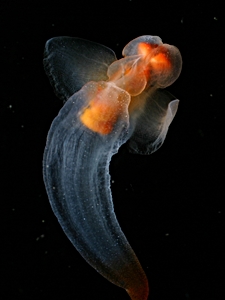 Clione limacina, Clionidae. Arctic Sea. Photo: Kevin Raskoff (Source). |
Apart from that, terrestrial gastropods also found a way to hide themselves
from predators with a shell colour optimally adapted to their preferred habitat.
An example can be the tree snail (Arianta
arbustorum) or even the colourful banded snails
(Cepaea hortensis and Cepaea nemoralis). Some snails even
protect themselves with hairs on their shells, such as the
leaf snails (Hygromiidae) or
cheese snails (Helicodontidae). Others even
hide themselves by covering their shell with dirt, such as the
Lesser Bulin (Merdigera obscura) (
Camouflage).
Snails evolving into slugs discard all those advantages for the benefit of another advantage: Agility. This can especially well be seen in a predator-prey pair on marine gastropods living in the ocean: The Sea Angel (Clione limacina, Picture on the right) in the order Pteropoda, a sea slug swimming freely in the ocean, hunts for Sea Butterflies (Limacina helicina). The latter, a member of the same order, hunt for jellyfish, but since they still carry an albeit thin and translucent shell, they are slower and thus easy prey for a sea angel.
The colourful nudibranch sea slugs (Nudibranchia) on the other hand, use their colourful dorsal appendages to warn potential predators not to attack them. This threat is also bolstered by those sea slugs feeding on jellyfish and retrieving their nettle cells. Those then are stored in the dorsal appendages of the nudibranch and used as a defensive weapon against any attacker foolish enough to ignore the initial warning. Finally, in another group of sea slugs, the side-gill slugs ('Notaspidea'), there are species that benefit of symbiotic bacteria living in their tissue, providing them with a deadly poison, Tetrodotoxin (TTX), similar to that of bluering octopuses (Hapalochlaena) and pufferfish.
 Hermann Löns observing an Arion slug. AI Illustration by Robert Nordsieck. |
Wikipedia:
Hermann
Löns.
The sticky slime also makes it hard for a predator to swallow a slug. Hedgehogs, for example, who love eating snails and slugs, sometimes have to roll a slug on the earth to be able to eat them. Also, several slug species can contract strongly, which makes it even harder to swallow them.
Many terrestrial slug species, such as the worm slugs (Boettgerillidae), for most of their time live underground. Here, desiccation is less of a threat, and agility becomes that much more important. An entire shell would instead be rather cumbersome.
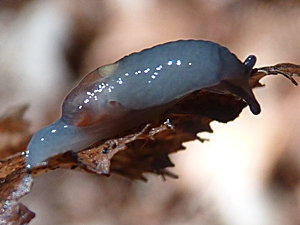 Ear-shaped Glass Snail (Eucobresia diaphana) from the Vienna Woods. Photo: Martina Eleveld. |
|
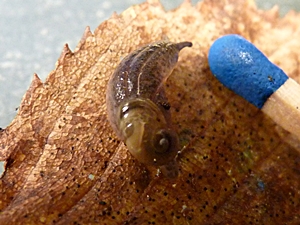 A Daudebardia from the Vienna Woods, species unclear. Photo: Martina Eleveld. |
A similar development has taken place in the hunchback-shaped jumping slugs (Hemphillia) from northwestern America, as well as in several exotic species. In other groups, such as the carnivorous daudebardias (Daudebardiinae as a part of the Oxychilidae family of glossy snails), the shell has shrunk to a small shell rest shaped like a mussel, worn on the tail end of the body. The same as the so-called shell slugs (Testacellidae), they both are carnivorous and mostly live underground hunting earth worms. Since they both still retain a small (rudimentary) shell rest they cannot withdraw into, they are also called semi-slugs or half-slugs.
The final stage in the shell reduction of terrestrial gastropods are complete slugs with no remaining external shell left. But even in those groups, though only visible by anatomic means, shell rests can still be found beneath the mantle shield, such as among the keel back slugs (Limacidae and Milacidae). In the round back slugs (Arionidae) on the other hand, the shell has even further been reduced to only several calcareous granules remaining in the slugs's body.
While this process can be called "vitrinisation" (after the Vitrinidae family mentioned before), in the English language and thus also in most of the scientific discourse, the term "limacisation" is much more commonly used. The term was coined by the American malacologist Alan Solem in his 1974 book "The Shell Makers", derived from the Latin word Limax for a slug in general and the genus Limax in the Limacidae family in particular.
Glass Snails (Vitrinidae).
Vitrinisation or Limacisation: Shell reduction
in gastropod groups.
Solem,
G.A. (1974): "The Shell Makers". Wiley, New York, 1974. Ch. 12, pp.
210 - 230. (Link).
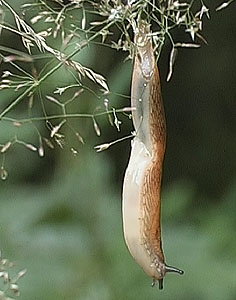
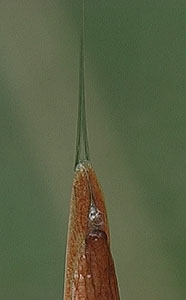 Round-back slug (Arionidae) roping down on its own slime thread. Close-up on the right. Photos: Andreas Heidl. |
In Europe, there is mainly the distinction between the large round back slugs (Arionidae) and keel back slugs (Limacidae), of which the largest species, the Black Keel Back Slug (Limax cinereoniger) can grow to over 20 cm in length. Both groups also contain noticeably smaller species, however other groups of smaller slugs would be the tiny, mostly subterranean worm slugs (Boettgerillidae) and the equally tiny Milacidae and field or garden slugs (Agriolimacidae).
Different Kinds of European Slugs.
Keel back slugs (Limacidae).
Clemens M.
Brandstetter:
Nacktschnecken auf
Wirbellose.at
(in German).
Naturportal Südwest:
Nacktschnecken (in German).
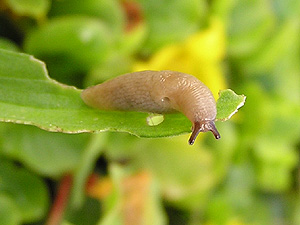 The Grey Field Slug (Deroceras agreste) can also become a garden pest. Photo: Robert Nordsieck. |
|
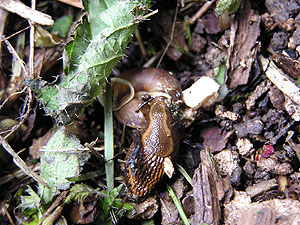 A juvenile Spanish Slug (Arion vulgaris) feeding on a rock snail (Helicigona lapicida). Photo: Robert Nordsieck. |
Slugs protect themselves mainly using their particularly sticky slime, covering their entire body. The slime also is hygroscopic, thus preventing the loss of water because of desiccation. Many slugs can also defend themselves by contracting strongly. The blood pressure from within works against the constriction of the body wall muscles, thus the body becomes hard and resistible. Together with the foul-tasting slime, that is a usable obstacle for most snail eating predators.
Some slug species use their slime not only for protection but also during mating: The almost artistic mating act of several keel back slug species (e.g. Limax maximus) also includes roping down together from an elevated position such as a branch or rock and mating in free air hanging from that slime thread. Some slug species also use the slime thread to get down from a branch to reach the ground or another branch.
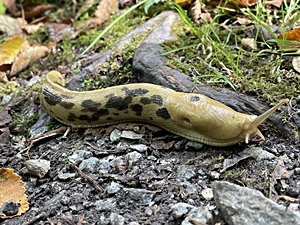 Banana Slug (Ariolimax columbianus): Lawton Park, Seattle, Washington, USA. Photo: Jamie Axall (iNaturalist). |
Other species do hibernate and spend the winter underground, like their eggs, where they are protected from the frost.
Most large slug species eat almost anything edible, they can be found in salad, on dungheaps, as well as near dead earthworms and other roadkill. Forest-dwelling species, such as the Black Keel Back Slug (Limax cinereoniger) especially like feeding on mushrooms, so the traces their rasping tongues leave behind can easily be seen when foraging for mushrooms in autumn.
Some slug
species are omnivorous, they even feed on other
gastropods, some even on their own kind.
Some slug species are garden pests. Among the most notorious is the so-called Spanish or Lusitanian Slug (Arion vulgaris). It had previously been assumed to have migrated from Portugal or Spain, but since today it is thought to be more likely they are the result of either a mutation or hybridisation of domestic European Arionid slugs, the species has been renamed Arion vulgaris (translated literally to "Common Slug") from Arion lusitanicus, supported by the fact that there still is a species by the name Arion lusitanicus in the original region, which was determined not to be the same species.
Other garden pests are smaller species, such as the aptly named Garden Slug (Arion hortensis), as well as several species of other garden and field slugs (Deroceras reticulatum and agreste).
Snails and Slugs – Terror of the Gardener?
Well known American slug species are for example the so-called Banana Slug (Ariolimax columbianus, Family Ariolimacidae), the mascot of the UCSC university in Santa Cruz, Calfornia, and the Florida Leatherleaf (Leidyula floridana, Family Veronicellidae). Apart from those, there are also several European slug species that have been introduced to North America, much to the chagrin of local agriculture, such as the Leopard Slug (Limax maximus) and especially the Netted Field Slug (Deroceras reticulatum).
Latest Change:
27.07.2026 (Robert
Nordsieck).
Latest Link Check: 11.07.2026

