
| Diese Seite auf Deutsch! |
|
Amazing Facts About MolluscsMollusca Cuvier 1797 |
Welcome to molluscs.at, the homepage about the Living World of Molluscs!
 Opalescent Squid (Doryteuthis opales- cens), a cephalopod. |
|
 Pea Clam (Pisidium), a bivalve. |
|
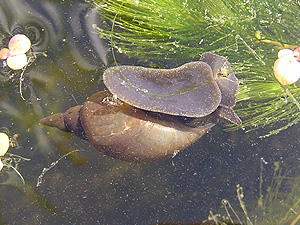 Greater Pond Snail (Lymnaea stagnalis), a gastropod. |
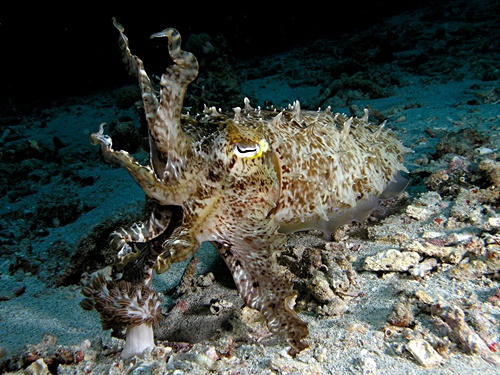 Cuttlefish (Sepia) near Komodo Island (Indonesia). Photo: Nick Hobgood. |
 |
The French naturalist Georges Cuvier first described the molluscs in 1797, only 39 years after Carl Linnaeus had published his groundbreaking paper Systema Naturae in 1758, which laid the foundations of modern biological classification.
 Milestones in biological systematics.
|
Today, eight extant classes of molluscs are recognised:
|
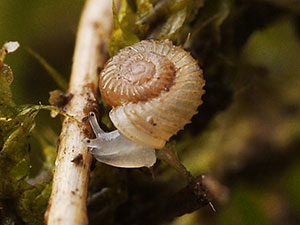 Ribbed Grass Snail (Vallonia costata). Photo: © Stefan Haller (schneckenfoto.ch). |
|
Who would have imagined that a snail slowly crawling on the forest floor, a fast-moving squid pursuing prey through the sea, and a pond mussel sitting motionless at the bottom of a lake all belong to the same animal group? Or that a tiny snail measuring only 0.3 millimetres and a 15-metre giant squid could be relatives?
And yet they are: all these animals are molluscs (Mollusca), and despite their very different appearance, they share a number of important characteristics.
Molluscs are not only fascinating from a biological perspective. In antiquity, a valuable dye was obtained from murex snails and reserved for the most distinguished individuals, including the famous warriors of Greece, Roman senators and, above all, the Roman emperor himself. Some bivalves produce pearls, while others provide the shimmering mother-of-pearl used in jewellery and decorative art. Since prehistoric times, humans have used molluscs as a food source, as demonstrated by archaeological evidence.
Molluscs have also played a role in the cultural history of many peoples. The triton shell, a large marine snail, was used as a musical instrument. Cowry shells served as currency in parts of Africa, Asia and Oceania for long periods of time. The mysterious squids and octopuses of the deep sea inspired legends ranging from the stories of Odysseus to Jules Verne's "Twenty Thousand Leagues Under the Sea".
 On the other hand, many mollusc species,
particularly marine forms, are used in jewellery, not to mention the importance
of oysters,
mussels and various
marine snails as highly valued seafood.
On the other hand, many mollusc species,
particularly marine forms, are used in jewellery, not to mention the importance
of oysters,
mussels and various
marine snails as highly valued seafood.
Finally, since the Age of Exploration at the latest, snails and shells have become an integral part of many cabinets of curiosities and natural history collections. Apart from the scientific importance of the mollusc collections held in many museums, which in some cases originated from such collections, there are still many people today who collect shells and snails simply out of interest and enjoyment. Unfortunately, many species, especially the rarer ones, have become scarce partly for this reason.
Despite their many uses and their fascinating diversity, molluscs still remain a relatively overlooked group of animals for many people. This website aims to change that by introducing you to the remarkable world of snails, bivalves and cephalopods.
Immerse yourself in a world that often remains hidden - and is all the more astonishing because of it.
Enjoy reading, learning and exploring!
Yours, Robert Nordsieck.
 "The Living World of Molluscs" on https://www.molluscs.at by Robert Nordsieck for 25 years: 2000 - 2025! |
 The
Youtube channel of Weichtiere.at with several video clips ready to watch!
The
Youtube channel of Weichtiere.at with several video clips ready to watch!
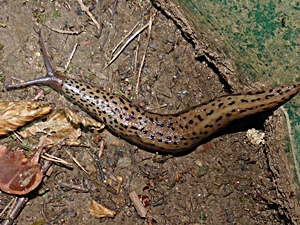
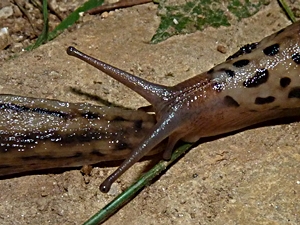
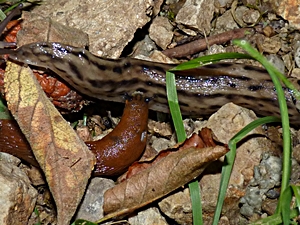
The page about
Leopard Slugs (Limax maximus) has been completely revised and now
shows many new pictures by
Martina
Eleveld,
together with a new
video playlist on the same topic on our
Youtube channel!
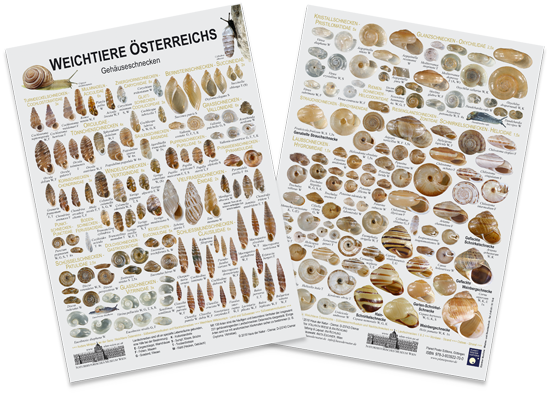
Picture:
Haus der Natur in Cismar.
Identification charts "Molluscs of Austria - Snails with a Shell" and
"Molluscs of Austria - Fresh Water Snails and Slugs"
Additional Information!
(In German).
Available in the
Vienna Natural History
Museum and in the Haus
der Natur in Cismar, Germany.
Overview over German and Dutch identification charts:
http://www.miniposter.hausdernatur.de/.

http://www.mollusca.de:
Homepage of the
German Malacozoological Society all about mollusc research.

Molluskenforschung Austria
Austria-wide
platform for mollusc researchers.
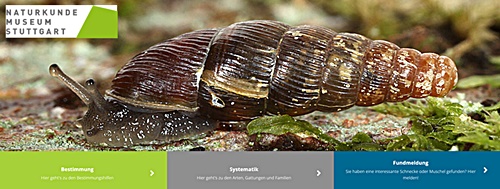
Naturkundemuseum Stuttgart: Molluscs -
Identification, Systematics, Finding Reports.

Molluscs at Naturschutzbund Deutschland (NABU)
(German Nature Conservation Society)
Latest Change:
01.07.2026 (Robert
Nordsieck).
Latest Link Check: 24.05.2026.
