
| Diese Seite auf Deutsch! | |
Vitrinisation or LimacisationShell Reduction in Land Snails |
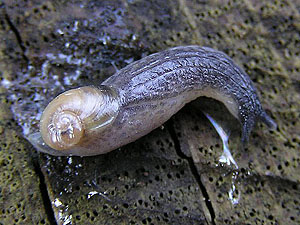 Reddish Daudebardia (Daudebardia rufa), a carnivorous snail, mainly feeding on earth worms. Source: biolib.cz (Jiří Novák). |
|
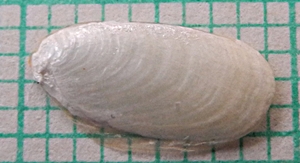 Shell rest of Limax maximus. Size: < 2 cm. Picture: Jonathan Neumann. |
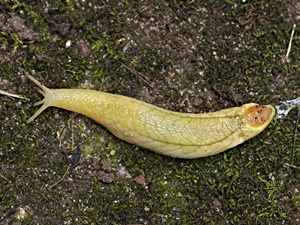 Yellow-gray shell slug (Testacella haliotidea). Photo: M. Gurney (Flickr.com).  Enlarge!
 |
The family Testacellidae, commonly known as the Shelled Slugs and distributed throughout western Europe, also hunts earthworms underground and likewise possesses only a small reduced shell remnant on the posterior part of the body, into which the animal can no longer withdraw. However, the two groups are not closely related. While the Daudebardiinae belong to the Glass Snails (Oxychilidae), the Testacellidae form part of the Oleacineoidea and are related to predatory species such as the Rosy Wolf Snail (Euglandina rosea) and the Dalmatian Predator Snail (Poiretia cornea).
Snails like that, with a strongly reduced shell that remains present only as a remnant, are often referred to as semi-slugs.
Walter Wimmer
(German):
Halbnackte Räuber im Harz - Bikinischnecken jetzt entdecken.
Francisco Welter
Schultes:
Daudebardia rufa species homepage.
Francisco Welter
Schultes:
Testacella haliotidea species homepage.
Animal FactFiles:
Glass
Snail: the Winter Snail.
( YouTube Video).
Different stages of shell reduction can be observed particularly well among the following three slug families: the Roundback Slugs (Arionidae), the Keel Back Slugs (Limacidae), and the Milacidae. While the Keel Back Slugs and Milacidae still retain an internal shell remnant, the Roundback Slugs possess no detectable shell remnant at all, apart from a few calcareous granules that remain after decomposition of the soft body. This situation is comparable to that seen among cephalopods, where octopuses (Octopodidae), squid (Loliginidae), and cuttlefish (Sepiidae) display varying degrees of shell reduction.
Especially in the English language and also mostly in scientific discourse, another term is usually used: Limacisation. Coined by the American malacologist Alan Solem in his 1974 book "The Shell Makers", the term is derived from the Latin word Limax for a slug in general, as well as for the Limax genus in the Limacidae family of slugs.
Tanya Loos:
A Guide to the Land Snails of Australia.
Simone,
L.R. (2018): "Main processes of body modification in gastropods: the
limacization". Malacopedia 1, 12-22 (PDF).
Solem,
G.A. (1974): "The Shell Makers". Wiley, New York, 1974 (Link).
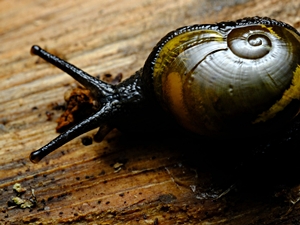 Helicarion cuvieri: Lorne, Victoria, Australia. Photo: Peter Crowcroft (iNaturalist). |
|
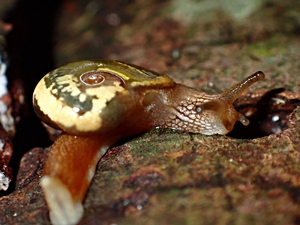 Helicarion mastersi: Jamberoo, New South Wales, Australia. Photo: Emily Sonter (iNaturalist). |
|
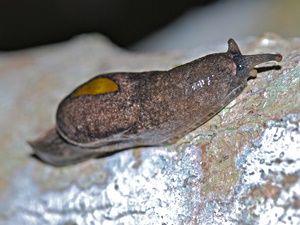 Parmarion martensi (Malaysia). Photo: Bernard Dupont. |
The family Helicarionidae, for example, occurs in the eastern Palaearctic region (see Faunal Provinces of Earth), Madagascar, India, Southeast Asia and Australia. The scientific name itself reflects the peculiar nature of the family: these snails appear to represent a mixture of a shelled snail (Helix) and a slug (Arion). In reality, however, Helicarionidae are more closely related to the Limacidae than to the Arionidae.
The Australian species of the type genus Helicarion exhibit a pattern of vitrinisation similar to that of the European glass snails (Vitrinidae). While Helicarion cuvieri still possesses an almost complete shell, in Helicarion mastersi the shell is already partly overgrown by the mantle. Similar to many European glass snails, Helicarion mastersi develops a mantle lobe covering large portions of the shell. Another remarkable feature is that species of the Helicarionidae produce a love dart composed of chitin rather than calcium carbonate, as is found, for example, in the Helicidae.
In 2017, the genus Attenborougharion was newly described from Tasmania. In addition to its strikingly colourful appearance, it also exhibits a fairly advanced stage of vitrinisation.
 |
| Wikipedia: Helicarionidae. |
| |
| MolluscaBase eds. (2025): Helicarion cuvieri A. Férussac, 1821. |
| |
| Hyman, I., Köhler, F. (2017): Attenborougharion gen. nov.(Mollusca: Pulmonata: Helicarionidae): A likely case of convergent evolution in southeastern Tasmania. Rec. Aust. Mus. 69/2, pp. 65–72. |
 Dromedary jumping slug, Hemphillia dromedarius). Picture: Kristiina Ovaska. |
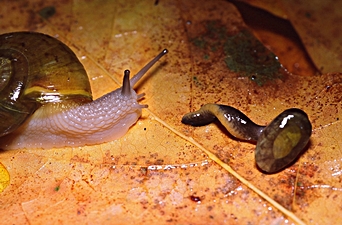 Robust lancetooth (Haplotrema vancouverense, left) and Dromedary jumping slug (Hemphillia dromedarius, right). Picture: Kristiina Ovaska. |
The situation is different in North America, however. There, species occur that are known as Humpback Slugs (Hemphillia dromedarius) or, alternatively, as Jumping Slugs. The former name refers to the fact that a relatively large shell remnant is still present and is covered only by the mantle, forming a hump-like structure on the animal's back. The latter common name derives from a remarkable escape strategy used against predators: by rapidly striking and twisting their tail, these animals are able to propel themselves away from danger in a movement that resembles jumping.
A similar appearance can also be found in the Yellow-shelled Semi-slug (Parmarion martensi) of the family Ariophantidae. This species, probably originating from Southeast Asia, has been introduced into the western United States and has become an agricultural pest in some areas, such as Hawaii. In addition, it can act as a vector for nematodes, including the Rat Lungworm Angiostrongylus cantonensis.
| |
| Hollingsworth et al. (2007): "Distribution of Parmarion cf. martensi (Pulmonata: Helicarionidae), a New Semi-Slug Pest on Hawai‘i Island, and Its Potential as a Vector for Human Angiostrongyliasis". Pac. Sci. 61(4): 457-467. (Link). |
| |
| Cowie, R. H., Dillon R. T., Robinson, D. G., Smith, J. W. (2009): "Alien non-marine snails and slugs of priority quarantine importance in the United States: A preliminary risk assessment". Amer. Malac. Bull. 27: 113-132. (Link). |
Finally, there are also slugs that do not resemble the familiar European forms, in which the mantle occupies only the anterior part of the body and forms a shield-like structure (the mantle shield). In the North American slug Megapallifera mutabilis (family Philomycidae), for example, the mantle covers the entire body of the animal — which explains the name Megapallifera, meaning "bearer of a giant mantle". Members of the family Veronicellidae, for example, appear almost like a large crawling mantle, with even the tentacles only occasionally protruding from beneath it. Accordingly, these slugs are commonly known as Leatherleaf Slugs.
Megapallifera
mutabilis aus Massachusetts, USA:
Photo
by Paul J. Morris on Flickr.com.
Veronicellidae:
Caribbean
Leatherleaf (Sarasinula plebeia) on
Jaxshells.org.
Latest Change:
10.07.2026 (Robert
Nordsieck).
Latest Link Check: 27.05.2026.