Bush Snails (Fruticicola)
Systematics
Class: Gastropoda
 Subclass:
Pulmonata
Subclass:
Pulmonata
Superorder:
Eupulmonata
Order:
Stylommatophora
Suborder:
Sigmurethra
Infraorder:
Arionoinei
Superfamily:
Helicoidea
Family:
Camaenidae
Subfamily:
Bradybaeninae Pilsbry 1934 (1898)
or:
Family: Bradybaenidae Pilsbry 1934 (1898).
 Source:
MolluscaBase (accessed 11.10.2022).
Source:
MolluscaBase (accessed 11.10.2022).
Gittenberger, E., Hamann,
T. D., Asami, T. (2012): Chiral speciation in
terrestrial pulmonate snails. (Link,
accessed 11.10.2022): There mentioned as Camaenidae: Bradybaeninae.
Naturportal Südwest (Homepage of the Stuttgart Natural History Museum):
Fruticicola fruticum.
Explanation of
shell characters as means of identification.
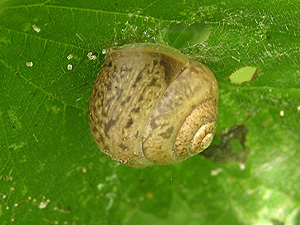
Bush snail (Fruticicola fruticum). [RN] |
|
|
Bush snails are placed together with the
leaf snails (Hygromiidae) and the
Helicid snails (Helicidae) into one superfamily, the
Helicoidea.
The family is rich in species and has got the distribution centre in Central
and East Asia. There is only one species Fruticicola fruticum that is
distributed into Western Asia and Europe.
Bush Snail -
Fruticicola fruticum (O.F. Müller
1774)
| |
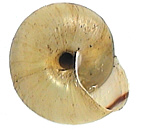 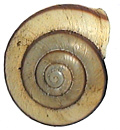
Fruticicola fruticum. Picture: Helmut Nisters. |
Description: The bush snail has got a globular, slightly flattened
shell, which is very variable in size. It is thinly walled and has got dense
fine wavy spiral lines. The umbilicus is open (about one seventh of the shell
diameter) and deep. The shell colour as its size, is very variable and can be
from grey white to reddish brown and even violet. Varieties also come into
existence when the soft body's colour shines through, as seen in the picture on
the left.
Dimensions: W: 13 - 23 mm; H: 10 - 19 mm; N: 5 - 6 ½.
(Abbreviations).
Habitat and Distribution: The bush snail prefers alluvial forests and
bright bushes, it is in need of warmth but susceptible to dryness. It appears in
almost all of Europe, without the British Isles and the Northern and Southern
border areas.
Remark: In Kerney, Cameron,
Jungbluth (1983) Fruticicola fruticum is
mentioned with the obsolete name Bradybaena fruticum, which
still is sometimes used.
Reference
-
Anderson, R. (2008): "An annotated list of the non-marine Mollusca of Britain and
Ireland" (PDF).
-
Falkner, Fechter: "Weichtiere" (1990),
(in German).
- Kerney,
Cameron, Jungbluth:
"Die Landschnecken Nord- und Mitteleuropas"
(1983), (in German)
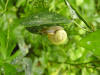
Bush snail (Fruticicola fruticum), a brown coloured specimen.
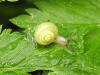
Bush snail (Fruticicola fruticum), a juvenile specimen.
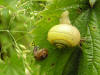
Bush snail (Fruticicola fruticum), another juvenile specimen.
Common hair snail (Trichia hispida), on the left, and a bush snail (Fruticicola fruticum) on the right.
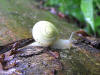
An adult bush snail (Fruticicola fruticum) on a fallen log.
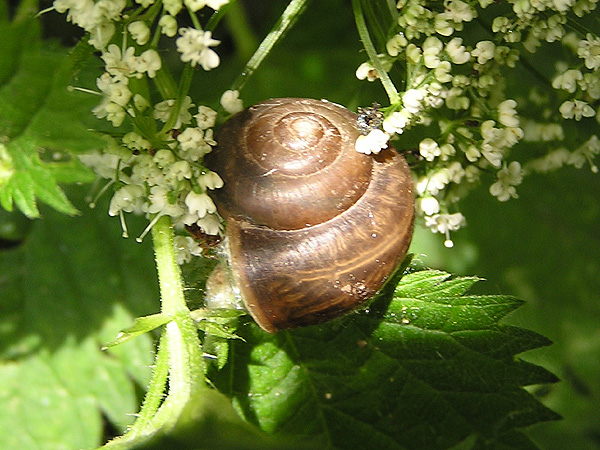
Bush snail (Fruticicola fruticum), a brown coloured specimen.
Pictures: Robert Nordsieck [RN]