| Diese Seite auf Deutsch! | |
Danube Mud SnailViviparus acerosus (Bourguignat, 1862) |
Class: Gastropoda
 Subclass:
Orthogastropoda
Subclass:
Orthogastropoda
Superorder:
Caenogastropoda
Order:
Architaeniglossa
Superfamily:
Ampullarioidea
Family:
Viviparidae J. E. Gray, 1847
 Source: Mollbase
on
https://www.mollbase.de/list/.
Source: Mollbase
on
https://www.mollbase.de/list/.
Taxonomy of
Gastropoda: Clade Caenogastropoda: Viviparidae.
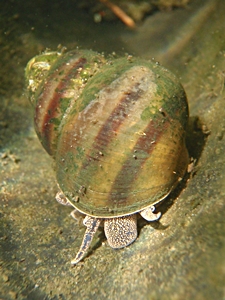 Danube Mud Snail (Viviparus acerosus). Photo: © Alexander Mrkvicka, Vienna. |
Description: The Danube Mud Snail generally has a yellowish green or grey shell with three reddish brown bands. The shell tip (apex) is very small, pointed and white. The lower whorls are separated by a deep suture between them. In older specimens' shells the shell tip is often lost to erosion, so confusions with other related species are possible. Like in most mud snails, the males are smaller and more slender than the females. Their shells have less and more flattened whorls. The last whorl of female specimens can be strongly extended. The shell mouth is oval and moderately pointed towards the upper end, and therefore so is the operculum.
Size: H: 30 - 50 mm; W: 25 - 35 mm; N: 6 - 7.

Habitat and Distrbution: The Danube Mud Snail lives in large rivers or lakes, as well as oxbow lakes in the Danube river system. The species prefers sandy or muddy ground. The distribution area of Viviparus acerosus only moderately spreads into Germany, where the species lives isolated near Passau and Geislingen. Continuously, Viviparus acerosus lives downstream from Vienna, subspecies or races are described from Romania and Bulgaria.
Threat Assessment: Until 2009, populations in Austria, especially in the
Danube Floodplains National Park, had strongly decreased - in Austria, the
species is considered nearly extinct. While Viviparus acerosus is
stated as critically endangered in Bavaria and Austria, in remaining Germany it
is considered endangered, in Czechia as threatened (
IUCN Threat
Categories).